

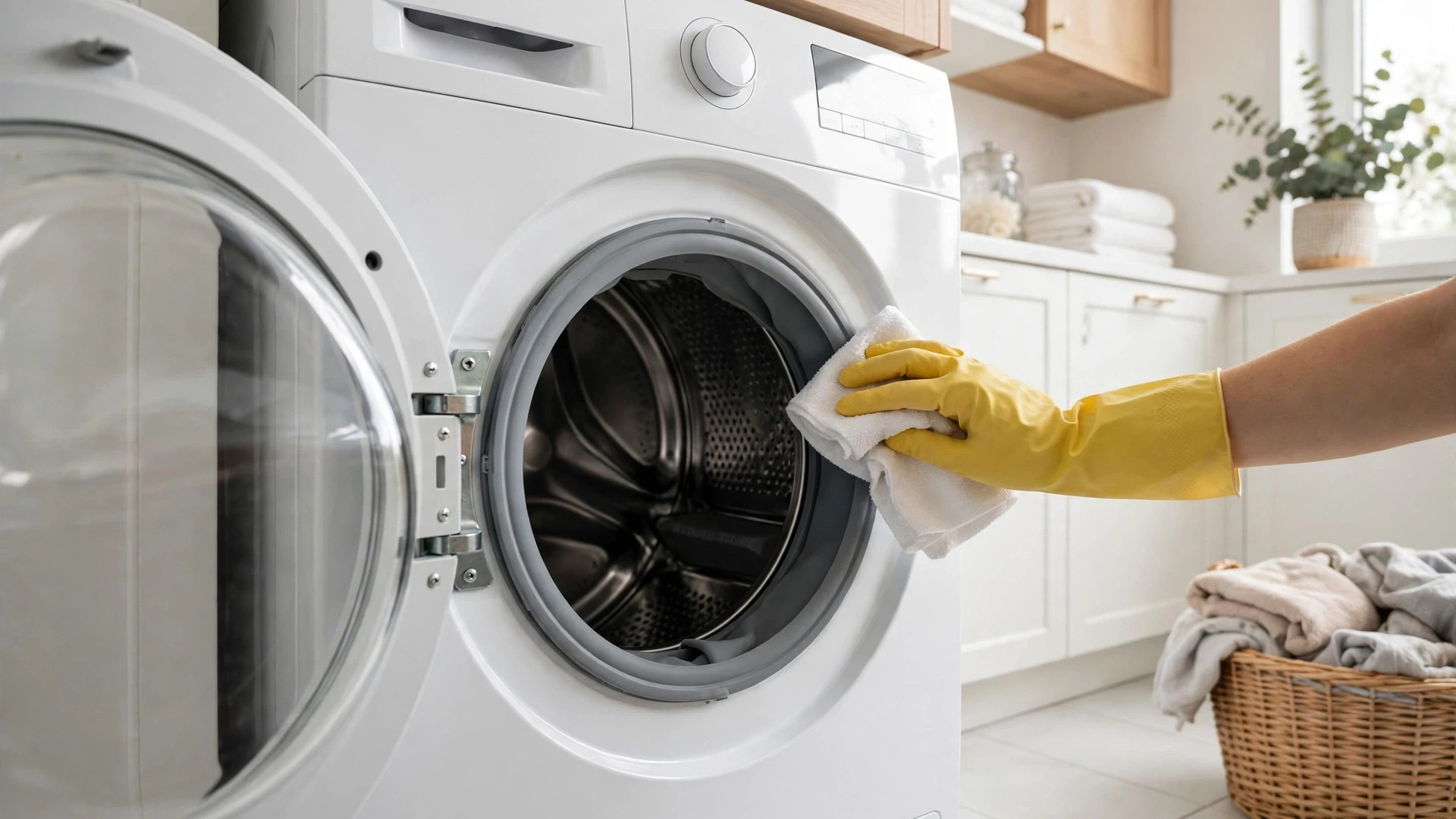
You open the washer expecting clean laundry and get hit with a sour, swampy smell instead. Maybe your towels come out smelling worse than when they went in. You’re not imagining it, and your machine isn’t broken — but it is overdue for a cleaning.
Here’s the irony: the appliance that cleans everything else can’t clean itself. Low-water, efficient wash cycles leave behind detergent residue, softener, body oils, and moisture — exactly what mold and mildew need. The fix takes about an hour, costs almost nothing, and works immediately.
This guide covers the full deep-clean — gasket, drum, dispenser drawer, and the drain pump filter most people don’t know exists — for front- and top-loaders, plus the habits that keep the smell from coming back.
Table of Contents
- Why Your Washing Machine Smells
- Front-Loaders vs. Top-Loaders: What Changes
- What You’ll Need
- The Deep Clean, Step by Step
- The Vinegar Question: Is It Safe for Your Washer?
- Keep It Fresh: 7 Prevention Habits
- When the Smell Signals a Real Plumbing Problem
- Common Mistakes to Avoid
- Frequently Asked Questions
- The Bottom Line
Why Your Washing Machine Smells
A smelly washer almost always comes down to one of these four:
1. Mold and mildew in the rubber gasket. On front-loaders, the thick rubber seal around the door traps water in its folds after every cycle. That dark, damp crevice is mildew’s favorite spot in your house. Pull the gasket back gently and look — black or pinkish spots and slime are the classic signs.
2. Detergent and fabric softener buildup. Modern washers use far less water than older machines, so undissolved detergent, softener, and body oils don’t fully rinse away. They coat the drum, hoses, and outer tub with a sticky film that smells like old gym socks once bacteria move in.
3. A clogged drain pump filter. Front-loaders (and some top-loaders) have a small filter that catches coins, hair, and lint before water drains. When it clogs, dirty water sits in the machine instead of draining fully. Most owners never clean it because they don’t know it’s there.
4. Too much detergent. If you fill the cap to the line out of habit, you’re probably using two to three times what a high-efficiency washer needs. The excess doesn’t make clothes cleaner — it leaves residue that feeds odor. Clothes that feel slightly stiff or filmy are the tell.
Cold-water washing makes all of this worse: it’s the right call for most loads, but cold water doesn’t dissolve residue the way hot water does. That’s why a monthly hot cleaning cycle matters even if everything else gets washed cold.
Front-Loaders vs. Top-Loaders: What Changes
The process is the same for both, but the trouble spots differ. Here’s where to focus:
| Cleaning task | Front-loader | Top-loader |
|---|---|---|
| Biggest odor culprit | Rubber door gasket — check the folds every month | Under the lid rim and around the agitator or impeller base |
| Deep-clean cycle | Use the “Clean Washer” / “Tub Clean” cycle if your machine has one; otherwise the hottest, longest cycle | Same — fill on the hottest, largest-load setting and let it agitate |
| Gasket/seal cleaning | Essential — pull back folds and wipe thoroughly | No gasket; wipe the lid seal and the top rim of the tub instead |
| Dispenser drawer | Pulls out from the front — remove and soak it | Usually a cup or tray under the lid — remove and scrub |
| Drain pump filter | Almost always present — small access door near the bottom front | Less common; check your manual — some have a lint filter instead |
| After every wash | Leave the door ajar — non-negotiable for front-loaders | Leave the lid open for an hour or so |
Front-loaders deserve their worse reputation: the airtight seal that makes them efficient also traps moisture. But top-loaders aren’t immune — cold washes, too much detergent, and a slammed-shut lid will get them smelling eventually too.
What You’ll Need
You don’t need specialty products to start:
- White distilled vinegar (2 cups)
- Baking soda (1/2 cup)
- A few clean microfiber cloths or old towels
- An old toothbrush or small scrub brush
- A shallow pan or old towel (for the drain filter step — water will spill)
- Rubber gloves
Optional but useful: a commercial washing machine cleaner. Here’s how the options compare:
| Method | Best for | Typical cost | Notes |
|---|---|---|---|
| White vinegar + baking soda | Light to moderate odor; routine maintenance | A few dollars from your pantry | Cheap and effective, but see the rubber-seal caution below before making it a monthly habit |
| Washing machine cleaner tablets/powder | Moderate to heavy buildup; regular maintenance | Typically around $8–$15 for a multi-month supply | Dissolves residue without harming seals; what most manufacturers recommend |
| Chlorine bleach (1 cup) | Killing established mold and mildew | A few dollars | Strong disinfectant — never mix with vinegar, and skip it if your manual warns against it |
| Oxygen bleach (sodium percarbonate) | Odor plus dingy buildup; gentler than chlorine | Typically around $10–$15 per tub | Color-safe and septic-safe; a good middle ground |
Pick one method — never combine bleach with vinegar. That combination creates chlorine gas, which is genuinely dangerous.

The Deep Clean, Step by Step
Set aside an hour — most of it is the machine running itself; hands-on time is around 20 minutes.
Step 1: Clean the rubber gasket (front-loaders)
Start here — this is where the worst of the smell lives. Put on gloves, pull the rubber folds back, and look inside: gray slime, trapped hair, and possibly black mold spots.
Wipe every fold with a cloth soaked in a 50/50 vinegar-water mix, using the toothbrush on stubborn spots and the groove where the gasket meets the drum. For heavy mold, a diluted bleach solution (about 1 tablespoon per cup of water) works better — apply, wait 10 minutes, wipe clean.
Dry the gasket completely — leftover moisture just restarts the cycle.
Top-loader owners: skip the gasket, but wipe the underside of the lid, the lid seal, and the top rim of the wash basket, where residue collects.
Step 2: Run the hot cleaning cycle
Make sure the drum is empty — no clothes. Then:
- Vinegar method: Pour 2 cups of white distilled vinegar into the detergent dispenser (or directly into the drum). Sprinkle 1/2 cup of baking soda directly into the drum.
- Tablet method: Drop the cleaner in per the package directions, usually directly into the drum.
- Bleach method: Pour 1 cup of chlorine bleach into the bleach dispenser or drum.
Run the hottest, longest cycle your machine offers — many have a dedicated “Clean Washer” or “Tub Clean” cycle, which is ideal. No extra rinse needed; the cycle handles it.
One honest note: a monthly hot cycle uses more electricity than a cold wash, but it’s cheap insurance against rewashing smelly loads. For cutting energy use elsewhere, see our guide to reducing your electricity bill at home.
Step 3: Scrub the dispenser drawer
While the cycle runs, pull out the detergent dispenser drawer — on most front-loaders there’s a release tab; top-loaders usually have a removable cup or tray.
Soak it in hot water for 15–20 minutes, then scrub every compartment — fabric softener slots are the worst offenders; that blue gunk is a bacterial buffet. Rinse well, dry completely, and slide it back in, wiping out the grimy drawer cavity first.
Step 4: Clean the drain pump filter
This is the step most people skip — and often the one that fixes the smell. On front-loaders, find the small access panel near the bottom front; it usually pops open with a coin or flat screwdriver.
Put your pan and towel underneath — water will come out. Unscrew the filter cap slowly (counterclockwise), pull the filter out, and clear off the hair, lint, and coins. Rinse under hot water, scrub if needed, then screw it back in firmly; a loose cap leaks.
Can’t find a filter? Some top-loaders don’t have a user-serviceable one. Check your owner’s manual before forcing any panels open.
Step 5: Wipe down the drum and exterior
When the cycle finishes, wipe the drum interior with a clean damp cloth to catch loosened residue, then wipe the door glass, control panel, and exterior. Leave the door (or lid) wide open for several hours so everything air-dries.

The Vinegar Question: Is It Safe for Your Washer?
Vinegar shows up in nearly every washer-cleaning guide, including this one — so here’s the honest trade-off.
White vinegar is mildly acidic, and acid plus rubber don’t mix well long-term. Occasional use is fine, but weekly use — or vinegar left sitting in the dispenser — can gradually dry out rubber gaskets and hoses, leading to cracks and leaks. Several major manufacturers advise against frequent vinegar use for this reason.
Here’s the practical takeaway:
- Occasional deep cleans with vinegar (a few times a year): fine.
- Monthly maintenance: use a manufacturer-approved washing machine cleaner instead — formulated to dissolve buildup without attacking rubber, and what your owner’s manual most likely recommends.
- Never let vinegar sit in the machine for extended periods — run the cycle promptly after adding it.
Keep It Fresh: 7 Prevention Habits
A deep clean fixes the smell; these habits keep it from coming back:
- Leave the door ajar after every load — the single most effective habit, especially for front-loaders. Air circulation is the enemy of mildew; even an inch helps if you have small children.
- Use less detergent. High-efficiency machines typically need only 1–2 tablespoons per load — far less than the cap suggests. Suds left at the end of a cycle mean you’re overdoing it.
- Pull laundry out promptly. Don’t leave wet laundry sitting — clothes in a sealed drum for hours create the same swampy conditions as a closed door. Set a timer if you forget.
- Run a monthly maintenance wash. An empty hot cycle with a commercial cleaner stops buildup from accumulating — anchor it to a recurring routine like our fall home maintenance checklist.
- Wipe the gasket after your last load of the day. Ten seconds with a dry cloth keeps the seal from staying damp overnight.
- Cut back on fabric softener. Liquid softener is one of the biggest contributors to drum buildup. Dryer balls — or a half-cup of vinegar in the rinse occasionally — soften clothes with far less residue.
- Clean the drain filter every few months — two minutes, big payoff. Put it on the calendar.
When the Smell Signals a Real Plumbing Problem
Most washer odor comes from the machine itself, and the steps above will fix it. But sometimes the smell is telling you something else. Investigate further if:
- The smell is like rotten eggs (sulfur). That’s usually bacteria in the drain or standpipe. It can mean the drain hose lacks a proper high loop, letting dirty drain water siphon back into the machine.
- The smell persists after a full deep clean. If the deep clean changed nothing, the source is likely downstream: a biofilm-coated drain hose, a dry P-trap, or a venting issue.
- Water drains slowly or backs up. A sluggish drain lets dirty water linger in the machine. Our guide on unclogging a bathroom sink drain without chemicals covers the same mechanical approach.
- The smell is musty but centered on the drain area, not the drum. Check that the drain hose sits 4–6 inches into the standpipe — not jammed all the way down, which breaks the air gap — and that the standpipe’s P-trap is holding water.
If you suspect a drain or vent issue, this is plumber territory — persistent sewer-gas smells deserve a professional look. (While you’re in fix-it mode, a running toilet is another common water issue that’s usually a quick DIY repair.)
Common Mistakes to Avoid
- Mixing bleach and vinegar. This combination releases chlorine gas. Use one or the other — never both in the same session.
- Using vinegar as your monthly cleaner. Occasional use is fine, but frequent vinegar cycles can degrade rubber seals over time. Use a manufacturer-approved cleaner for routine maintenance.
- Closing the door right after the cleaning cycle. Sealing the machine up while it’s still damp undoes your work — leave it open for hours.
- Underestimating the drain filter. More water comes out than you expect — sometimes a quart or more. Use a bigger pan than you think you need.
- Forgetting the dispenser drawer cavity. People scrub the drawer and ignore the dark slot it slides into, which is just as grimy. Wipe it out too.
- Assuming more detergent means cleaner clothes. The opposite is true in HE machines. Excess detergent is the top cause of buildup — measure it, don’t eyeball it.
Frequently Asked Questions
Why does my washing machine smell like rotten eggs?
A sulfur smell usually comes from bacteria in the drain hose or standpipe, not the drum. Check that the hose forms a high loop and sits 4–6 inches into the standpipe. If the setup looks right, clean the drain pump filter and run a hot bleach cycle.
Can I mix vinegar and baking soda in the same wash cycle?
They work better separately. Vinegar is an acid and baking soda is a base, so they neutralize each other on contact — the fizz mostly cancels out. For the strongest effect, run a hot cycle with vinegar first, then a second with baking soda.
How often should I deep-clean my washing machine?
Run a maintenance cycle once a month — most manufacturers recommend this. Do the full deep clean (gasket, dispenser, drain filter) every three to six months, or sooner if odors return; cold-wash households and heavy softener users may need it more often.
Will a smelly washing machine make my clothes smell?
Yes. Bacteria and mold in the drum, gasket, and dispenser transfer onto laundry — which is why towels and gym clothes often smell worse after washing. If your “clean” laundry smells musty, the machine is the first place to look, not your detergent.
Why does my front-load washer smell worse than my old top-loader did?
Front-loaders seal airtight to be water-efficient, which traps moisture in the rubber gasket after every cycle. Top-loaders ventilate more freely through the lid. The same prevention habits fix both — door ajar, less detergent, monthly cleaning — but they matter more for front-loaders.
The Bottom Line
A smelly washing machine is a maintenance problem, not a broken appliance. Work through the gasket, drum, dispenser, and drain filter in that order, and you’ll almost always find the culprit. Then keep it fresh with the boring habits: door ajar, less detergent, a monthly hot cycle.
Sources: ENERGY STAR clothes washer guidance (energystar.gov/products); EPA Safer Choice (epa.gov/saferchoice); and your washer’s owner’s manual — LG, Samsung, and Whirlpool all publish model-specific care guides.

Welcome to Homeblesh! I'm a professional content writer with over five years of experience creating well-researched, practical, and reader-focused content for clients on Upwork and Fiverr. Now, I've dedicated my expertise to building Homeblesh, where I share helpful guides, honest recommendations, and actionable tips based on careful research and industry knowledge. My goal is to provide accurate, trustworthy information to help you make informed decisions while delivering clear, useful, and easy-to-understand content.
- Muhammad Imran

- Muhammad Imran

- Muhammad Imran

- Muhammad Imran


