

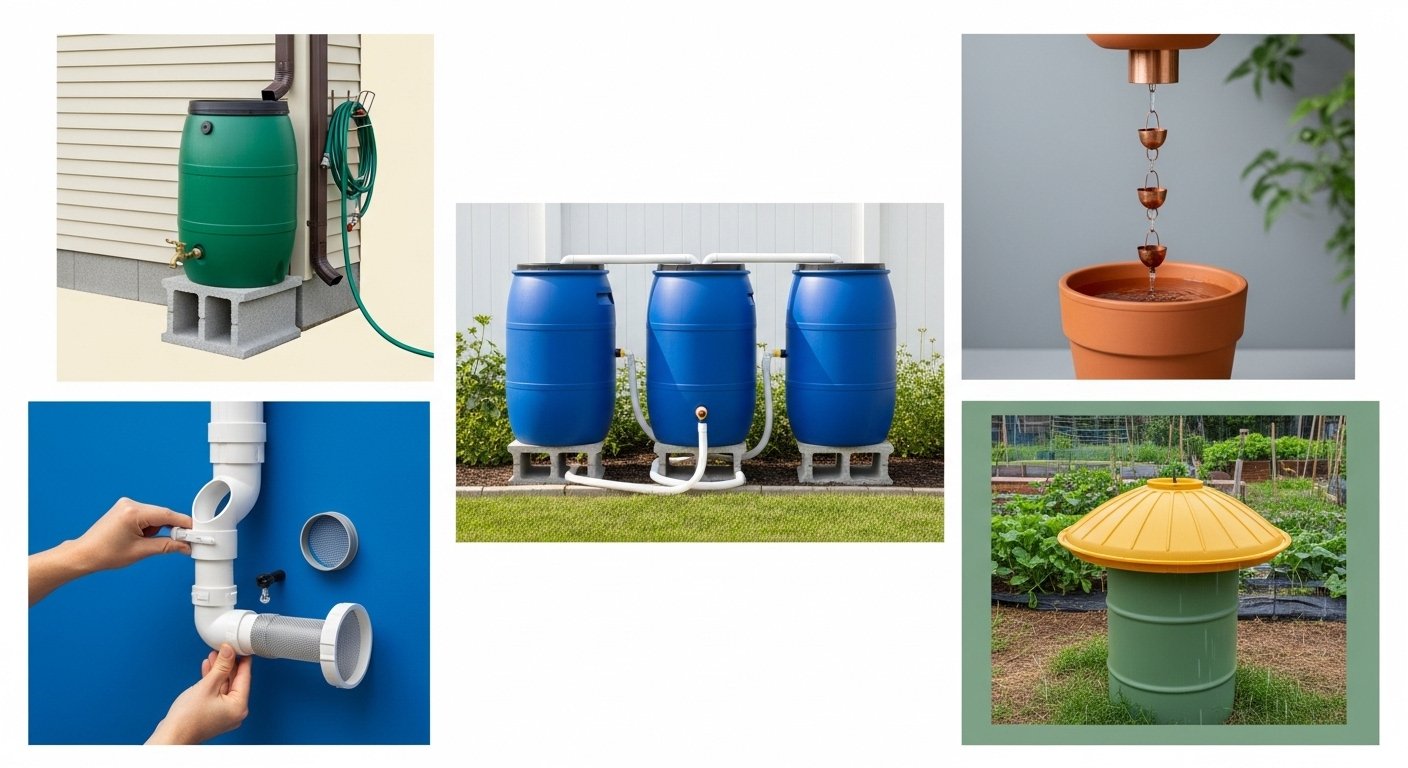
Every time it rains, thousands of liters of free, plant-nourishing water fall on your roof and run straight into the storm drain. It does not have to. With a few simple materials and a couple of hours, you can intercept that water before it disappears and put it to work in your garden instead.
Rainwater harvesting ideas do not need to be complicated, expensive, or technical to be genuinely effective. From a single 55-gallon barrel placed under a downspout to a connected multi-barrel system with a first flush diverter and gravity-fed irrigation.
There is a setup that suits every garden size, budget, and skill level. Beyond the obvious appeal of free water, rainwater is actually better for your plants than treated tap water. It is free of chlorine and fluoride, slightly acidic in a way that most plants love, and naturally oxygenated.
This guide covers the best rainwater harvesting ideas for home gardens in 2026, walking you through every option from the simplest beginner setup to more advanced systems, with practical tips for making each one work effectively from day one.

Table of contents
Why Rainwater Harvesting Makes Sense for Every Home Garden?
Before diving into the specific setups and methods, it helps to understand exactly why collecting rainwater is worth the effort and how significant the impact can be.
The Water Savings Are Substantial
Outdoor watering accounts for up to forty percent of total household water use during summer months in many regions. Depending on your roof size and local rainfall, even a basic single-barrel system can collect hundreds of liters during a single moderate rainstorm.
A 55-gallon barrel fills completely in as little as thirty minutes of moderate rainfall from a standard residential roof. Scale that up to a connected multi-barrel system and the storage capacity becomes genuinely significant.
Rainwater Is Better for Plants
Tap water in most municipal systems is treated with chlorine, fluoride, and other chemicals that are safe for human consumption but not ideal for plants or soil microbiomes.
Rainwater is naturally soft, slightly acidic, and free of those additives. Plants watered consistently with collected rainwater tend to show better growth, brighter foliage, and improved resistance to heat stress compared to those watered exclusively with municipal supply.
It Reduces Runoff and Erosion
In urban and suburban gardens, heavy rainfall creates runoff that carries soil, fertilizer, and pollutants into storm drains and local waterways. Capturing that water at the source reduces runoff volume, protects your garden soil from erosion, and contributes to a healthier local ecosystem.
The Financial Return Is Real
A basic rain barrel setup costs between thirty and eighty dollars if purchased pre-made, or as little as ten to twenty dollars as a DIY build using a repurposed food-grade barrel. The water savings in a typical garden over a single growing season comfortably cover that cost, making rainwater harvesting one of the fastest-return eco investments available.
Choosing the Right Rainwater Harvesting System for Your Space
Just like composting or sustainable bathroom upgrades, the right rainwater harvesting setup depends on your specific situation. Answering three questions helps narrow down the best option for you.
- How much space do you have? A small balcony or courtyard calls for a compact rain saucer or single slim-profile barrel. A larger garden with accessible guttering is ideal for a full barrel or multi-barrel setup.
- What is your primary water source? If your garden is fed primarily by a roof downspout, a barrel or diverter system is the most efficient choice. If you have open garden space without easy downspout access, a rain saucer or ground-level collector works better.
- Are you looking for storage or direct irrigation? Some systems are purely about storing water for manual use with a watering can or hose. Others can be configured with soaker hoses or drip irrigation lines for hands-free watering directly from the barrel.
Best Rainwater Harvesting Ideas for Home Gardens
1. The Classic Rain Barrel Setup
Best for: Beginners, small to medium gardens, anyone with a downspout near a garden bed.
This is the most widely used and beginner-friendly of all rainwater harvesting ideas, and it remains one of the most effective.
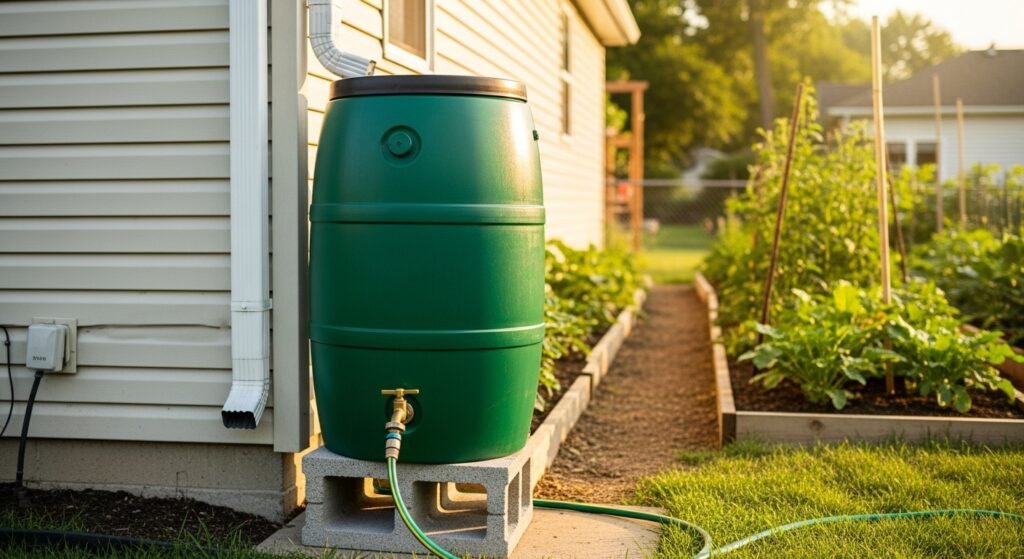
A rain barrel, typically a 55-gallon food-grade plastic container, is placed directly beneath a roof gutter downspout.
The downspout is modified with a simple diverter or cut to direct flow into the barrel’s opening, and a spigot near the base allows water to be drawn off with a hose or watering can.
How to Set Up a Rain Barrel:
- Step 1: Choose your barrel. A 55-gallon food-grade plastic drum is the standard choice. These are widely available secondhand from food and beverage manufacturers, car washes, and online marketplaces for very little cost. Make sure the barrel is completely clean and free of any chemical residue before use.
- Step 2: Install a spigot near the base. Drill a hole near the bottom of the barrel and fit a threaded brass spigot with a rubber washer to create a watertight seal. This is where you will connect a hose or fill a watering can.
- Step 3: Create the intake opening. Cut or modify the top of the barrel to accept water from the downspout. Cover the opening with a fine mesh or window screen to prevent debris, leaves, and mosquitoes from entering the barrel.
- Step 4: Modify your downspout. Install a downspout diverter kit, available from most hardware stores for under twenty dollars. This device sends water into your barrel when it is filling and automatically redirects overflow back down the original downspout once the barrel is full, preventing flooding around your home’s foundation.
- Step 5: Elevate the barrel. This is one of the most important practical tips for any rain barrel system. Raising the barrel on cinder blocks, a sturdy wooden platform, or a purpose-built stand does two important things. First, it creates enough clearance to fit a watering can under the spigot for easy filling. Second, the additional height creates gravity-fed water pressure, allowing a garden hose connected to the spigot to reach further into your garden without a pump.
2. Connected Multi-Barrel System
Best for: Larger gardens, households with higher water needs, anyone wanting to maximize storage capacity from a single downspout.
A single 55-gallon barrel fills quickly during moderate rainfall and may not hold enough water to see a garden through a dry spell between rain events.
A multi-barrel system solves this by linking two or more barrels together using a diverter kit and overflow hose, so water fills the first barrel completely before flowing into the second, then the third, and so on.
How to Connect Multiple Barrels:
Position your barrels in a row along a fence or wall near your downspout. Connect them using food-grade tubing running from a hole drilled near the top of the first barrel to a corresponding hole near the top of the second barrel. This overflow connection allows water to flow from barrel to barrel as each one fills.
Each barrel should have its own spigot near the base so water can be drawn independently from any point in the system. A final overflow outlet on the last barrel in the chain redirects excess water away from your home’s foundation once the entire system reaches capacity.
A three-barrel system with 55-gallon barrels provides 165 gallons of storage capacity from a single downspout, enough to supply a medium-sized vegetable garden through several days without rainfall.
3. Rain Chains as a Decorative Harvesting Element
Best for: Gardens where aesthetics matter, courtyard gardens, anyone wanting a visually appealing alternative to traditional downspouts.
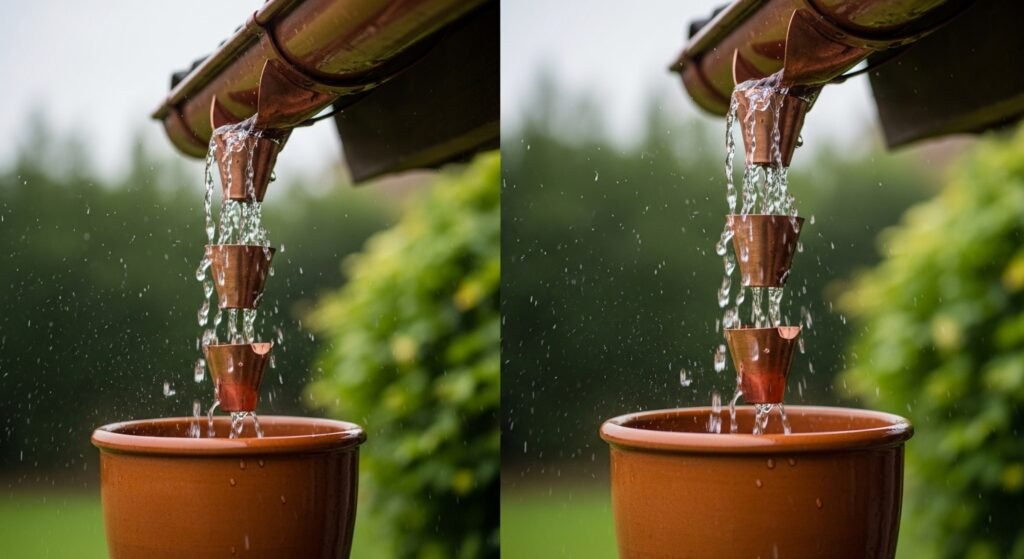
Rain chains are a Japanese-inspired alternative to closed downspouts that guide water from the roof gutter downward through a series of linked cups or rings, creating a beautiful cascading water feature during rainfall. They serve the same functional purpose as a downspout but do so in an elegant, visible way that becomes a genuine garden feature.
Rain chains work best when positioned over a collection barrel, a decorative container, or a gravel-filled channel that directs water to a garden bed or underground cistern. They are particularly effective in smaller courtyard gardens where a traditional downspout would feel industrial and out of place.
Rain Chain Installation Tips:
- Replace the existing downspout bracket with a rain chain hanging bracket at the gutter outlet
- Position a collection barrel or decorative container directly below the chain’s lower end
- Ensure the collection vessel has an overflow outlet to handle heavy rainfall
- Choose a chain style with closed cups rather than open links in heavy rainfall areas, as cups capture and direct more water with less splashing
4. Rain Saucers and Ground-Level Collectors
Best for: Balcony gardens, open garden spaces without guttering, renters who cannot modify existing downspouts.
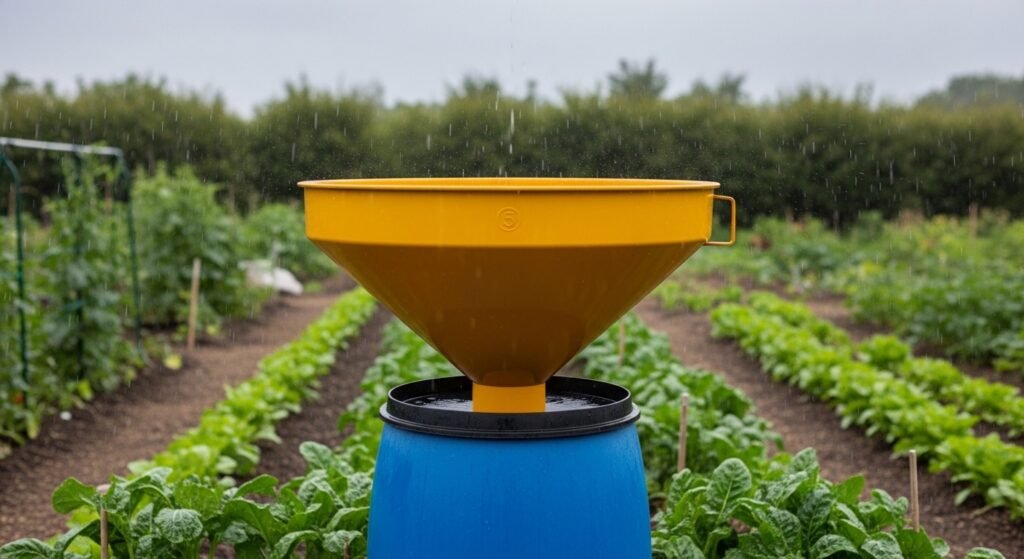
A rain saucer is a large funnel-shaped collector that sits above a standard barrel or storage container and captures rainfall directly from the sky, without any connection to guttering or downspouts. It is the most tool-free, landlord-friendly, and portable of all rainwater harvesting ideas, making it ideal for renters or anyone who cannot make permanent modifications to their property.
The collection surface of a rain saucer is typically between eight and twelve square feet, which is significantly larger than the barrel opening below it. This large surface area allows it to collect meaningful volumes of water even during light rainfall, funneling everything efficiently into the container below.
Ground-level collectors work on the same principle. A wide, shallow container placed in an open area of the garden captures direct rainfall and channels it through a tube or pipe into a storage barrel positioned nearby.
5. DIY First Flush Diverter System
Best for: Any barrel system where water quality is a priority, vegetable gardens, and edible plant irrigation.
One of the most important yet most overlooked components of any effective rainwater collection system is the first-flush diverter. The first rain that falls on a roof after a dry period washes off accumulated dust, bird droppings, pollen, leaves, and other debris. This first flush of water is the dirtiest and least desirable for garden use.
A first-flush diverter is a simple device installed between the downspout and the collection barrel that captures and discards the initial dirty water before allowing cleaner subsequent rainfall to flow into the barrel.
How a First Flush Diverter Works:
A vertical standpipe is installed in the downspout line with a capacity sized to capture the first gallon or two of runoff from the roof surface. This pipe fills with the initial dirty water, which slowly drains away through a small hole or ball valve at the base over the following hours. Once this standpipe is full, all subsequent cleaner water flows directly into the collection barrel.
A basic DIY first flush diverter can be built from standard PVC pipe fittings available at any hardware store for under fifteen dollars. It is one of the most impactful upgrades to any rain barrel system and is especially recommended for anyone using collected water on vegetable gardens or edible plants.
Important Tips for a Successful Rainwater Harvesting System
Always Use a Mesh Screen
Covering every opening with a fine mesh or window screen is non-negotiable. Without screening, barrels quickly become breeding grounds for mosquitoes, which lay eggs in standing water.
Debris and leaves also decompose in the barrel, creating unpleasant odors and clogging the spigot. A simple circle of mesh secured with a bungee cord or cable tie is all that is needed.
Use Your Stored Water Regularly
A common mistake is treating a rain barrel as a set-and-forget installation. In reality, regularly drawing down the stored water is essential for two reasons.
First, it keeps the barrel available to capture the next rainfall event rather than sitting full and missing the collection opportunity. Second, regularly cycling through stored water prevents stagnation and mosquito development even with a screened top.
Check Local Regulations Before Installing
In most regions, collecting rainwater from your own roof for garden use is completely legal and encouraged. However, some areas have specific regulations around storage volume limits or permitted uses. A quick check with your local municipality or water authority before installing your system is worthwhile.
Insulate or Winterize in Cold Climates
If you live in an area with freezing winters, drain your barrels completely before the first frost and store them upside down or in a garage. Water left in barrels will freeze, expand, and can crack the barrel or damage fittings. Recommission the system in spring when frost risk has passed.
Short Takeaways
If you are ready to put the best rainwater harvesting ideas into action in your garden, here is the quick version of everything covered:
- Start with a single 55-gallon rain barrel under your main downspout for an easy, low-cost beginning
- Elevate every barrel on cinder blocks or a platform for gravity-fed pressure and watering can clearance
- Always cover barrel openings with fine mesh to prevent mosquitoes and debris
- Add a first flush diverter for cleaner water, especially if irrigating edible plants
- Connect multiple barrels to maximize storage capacity from a single downspout
- Use rain chains as an attractive, functional alternative to standard downspouts
- Use stored water regularly to keep the system ready for the next rainfall
Frequently Asked Questions
Q: How much rainwater can a single barrel collect during one storm?
A standard 55-gallon barrel fills completely from approximately 1,000 square feet of roof surface during just one inch of rainfall. Most residential roofs are considerably larger, meaning a single barrel fills quickly and a multi-barrel system is well worth considering.
Q: Is collected rainwater safe to use on vegetable gardens?
Rainwater collected from a clean roof with a properly screened barrel and a first flush diverter is generally safe for vegetable garden irrigation. Avoid using water collected from roofs with lead flashing, treated wood, or asbestos-containing materials on edible plants.
Q: Do rain barrels attract mosquitoes?
Only if left unscreened. A properly fitted fine mesh screen over every opening prevents mosquitoes from accessing the water surface. Regular use of stored water also reduces the stagnation that mosquitoes require for breeding.
Q: Can I connect my rain barrel to a drip irrigation system?
Yes, with the barrel elevated sufficiently to provide gravity-fed pressure. A soaker hose or basic drip irrigation line connected to the spigot works well for slow, consistent watering of garden beds directly from the barrel.
Q: How do I prevent my barrel from overflowing during heavy rain?
Install an overflow hose from a hole near the top of the barrel that directs excess water away from your home’s foundation, ideally toward a garden bed, a rain garden, or a secondary storage barrel.

Welcome to Homeblesh! I'm a professional content writer with over five years of experience creating well-researched, practical, and reader-focused content for clients on Upwork and Fiverr. Now, I've dedicated my expertise to building Homeblesh, where I share helpful guides, honest recommendations, and actionable tips based on careful research and industry knowledge. My goal is to provide accurate, trustworthy information to help you make informed decisions while delivering clear, useful, and easy-to-understand content.
- Muhammad Imran

- Muhammad Imran

- Muhammad Imran

- Muhammad Imran


4 Comments
Pingback: 10 Budget Friendly DIY Home Improvement Projects
Pingback: DIY Accent Wall Ideas: Paint, Shiplap & Wallpaper - Home Blesh
Pingback: How to Build a DIY Compost Bin at Home: Step-by-Step Guide - Home Blesh
Pingback: What Are the Basics of Simple and Sustainable Living in 2026? - Home Blesh