
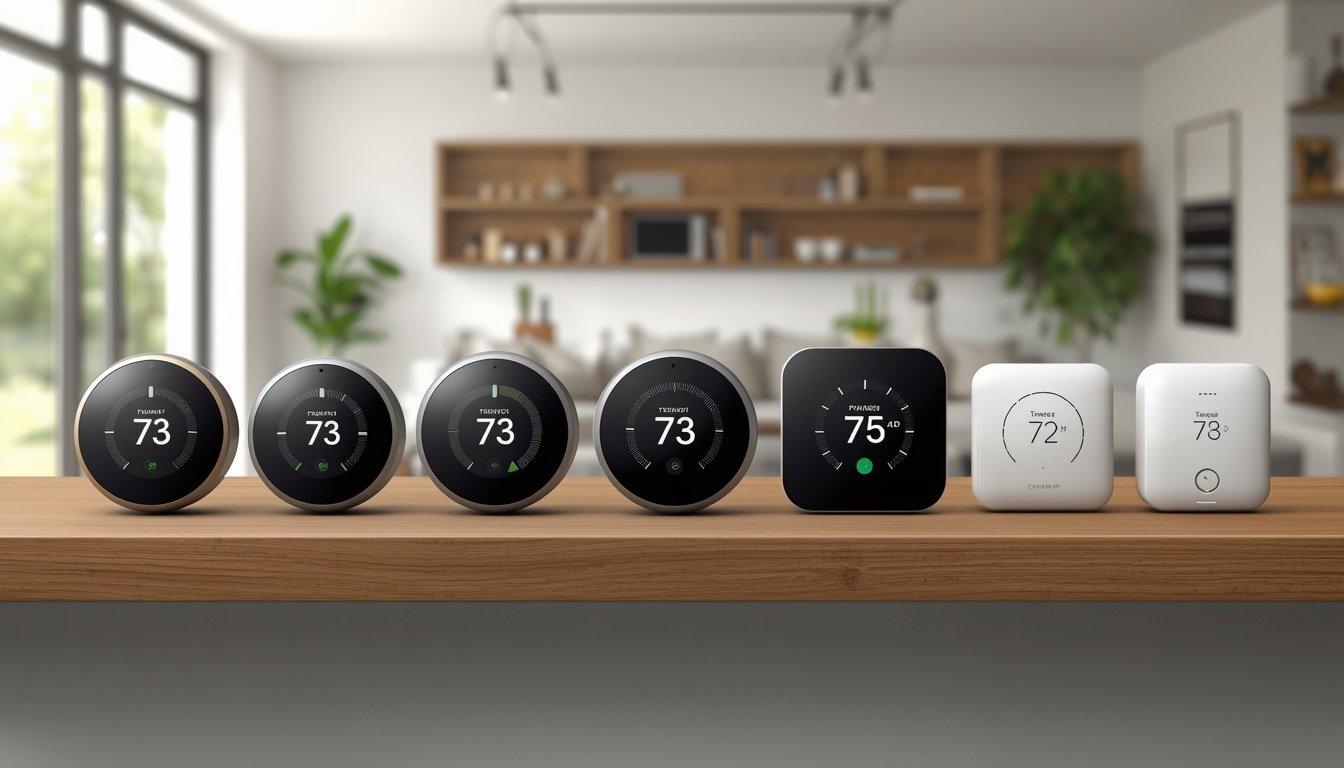
In 2026, managing home climate control has evolved from a matter of convenience to a financial necessity. With rising utility costs, finding the best smart thermostat is the single most effective way to optimize your HVAC system’s performance without sacrificing comfort.
Modern smart thermostats like the ecobee smart thermostat premium offer advanced features like eco+ optimization and air quality monitoring, while a dedicated HomeKit thermostat or Alexa thermostat can seamlessly integrate into your existing smart home routine.
But with so many options, you might wonder which smart thermostat saves the most money and which offers the best energy savings through utility rebates and demand-response incentives.
If you are looking for the best intelligent thermostat for self-learning automation or the best reliable Wi-Fi thermostat with straightforward app control, this guide breaks down the top models to help you slash your bills. Discover the leading energy-efficient smart thermostat options available this year and start maximizing your smart thermostat savings today.
Table of Contents
Why Smart Thermostats are Essential for 2026 Energy Savings?

Heating and cooling account for nearly half of the average American household’s energy bill and most of that money is wasted on empty rooms, forgotten schedules, and outdated equipment.
Smart thermostats change that equation entirely, shifting from rigid, user-programmed schedules to intelligent, self-learning systems that adapt to your behavior, occupancy patterns, and even local weather forecasts.
The financial case is compelling. According to the U.S. Environmental Protection Agency, ENERGY STAR certified smart thermostats save users an average of 8% on annual heating and cooling costs a modest-sounding number that compounds quickly over a device’s lifespan.
For a household spending $2,000 per year on climate control, that’s $160 back in your pocket annually, often offsetting the device’s purchase price within two years. The 2026 landscape adds even more urgency.
Utility rebate programs and grid demand-response incentives now reward homeowners who allow their thermostats to make real-time adjustments during peak load periods, turning a smart home upgrade into an ongoing revenue source rather than just a cost reducer. Pairing this with other home energy strategies can dramatically accelerate your return on investment.
The seven models ahead represent the best options available today, starting with the most data-rich choice on the market.
Best Smart Thermostats to Lower Your Energy Bills
1. Ecobee Smart Thermostat Premium: The Data-Driven Choice

For households that want the best smart thermostat backed by real environmental data, the Ecobee Smart Thermostat Premium stands out from the pack.
According to Ecobee’s product documentation, it’s the only mainstream thermostat that pairs a built-in air quality monitor with a premium zinc body, giving you both energy intelligence and indoor health awareness in a single device.
What truly separates this model is its remote sensor system. In practice, a single thermostat mounted in a hallway misses the temperature reality in your bedroom or living room.
Ecobee’s optional smart sensors detect occupancy and temperature in multiple rooms, eliminating the hot and cold spots that force your HVAC to overwork. The result is more even comfort and less wasted runtime.
- Place remote sensors in the rooms you use most, not just central areas.
- Enable Follow Me mode so the thermostat automatically prioritizes occupied spaces.
- Connect to HomeKit or Alexa for voice control and deeper automation routines.
Its dual-platform integration native Apple HomeKit and Amazon Alexa is unusually broad for a single device, making it the strongest choice for mixed smart-home ecosystems.
If whole-home comfort and air quality data matter as much as energy savings, the Ecobee Premium justifies its higher price and next, we’ll look at a model that earns savings through pure behavioral learning.
2. Google Nest Learning Thermostat: The Automation King

Often called the best intelligent thermostat for hands-off households, the Google Nest Learning Thermostat earns its reputation by eliminating the most common complaint about smart thermostats: nobody wants to program a schedule.
Within roughly one week of normal use, its proprietary learning algorithm observes your adjustments, maps them to time-of-day patterns, and builds a fully automated schedule no app setup required.
Key automation features at a glance:
- Adaptive scheduling: Tracks temperature preferences across different times and days, refining its model continuously
- Leaf icon gamification: A small green Leaf appears on the display whenever you choose an energy-efficient temperature, nudging behavior without lecturing
- Geofencing via Home/Away Assist: Uses your phone’s GPS to detect when everyone has left the building and automatically shifts to an energy-saving Away mode
That geofencing capability is where real savings emerge. According to a Nest Energy Services study, users saved an average of 10%–12% on heating and 15% on cooling largely because the system stops conditioning empty rooms.
Caveat worth noting: The learning model works best in households with consistent routines. Irregular schedules can slow optimization.
If you value full automation over manual control, the Nest Learning Thermostat delivers but if upfront cost is a concern, a capable budget alternative may close that gap faster than you’d expect.
3. Ecobee3 Lite: The Best Budget-Friendly Alternative

When the question is which smart thermostat saves the most money relative to its price, the Ecobee3 Lite makes a compelling case. According to CNET and Wirecutter, the Ecobee3 Lite runs similar energy-saving algorithms.
The Premium model offers SmartRecovery, scheduling, and geofencing at a noticeably lower entry price. Budget-conscious buyers aren’t sacrificing the features that actually move the needle on utility bills.
C-wire compatibility is another practical win. The Ecobee3 Lite includes a Power Extender Kit, making it compatible with most HVAC systems even if your home lacks a common wire a frequent barrier with other smart thermostats. Installation is straightforward enough for most DIYers.
Here’s a quick breakdown of the trade-offs:
- What you lose vs. the Premium: Built-in air quality monitoring, occupancy sensor included in the box, Siri voice assistant integration
- What you keep: SmartRecovery scheduling, geofencing, app control, ENERGY STAR certification, and the same bill-reducing algorithms
- Bottom line: Real-world energy savings are nearly identical to the Premium for the average household
If your priority is lower energy bills without paying for extras you won’t use, the Ecobee3 Lite is a cost-effective choice in this lineup though households wanting deeper home integration may want to read on.
4. Vivint Smart Thermostat: Best for Integrated Security

For households that already run a whole-home security system, a standalone thermostat can feel like a disconnected afterthought. Vivint closes that gap by integrating its thermostat directly into the broader security ecosystem, resulting in one of the most genuinely “set-it-and-forget-it” experiences available in 2026.
Occupancy detection is where Vivint pulls ahead of self-installed alternatives. According to Vivint’s product documentation, the system uses in-home security sensors, door contacts, and motion detectors.
And glass-break sensors to adjust temperatures based on actual room occupancy rather than relying on a single central hub. In practice, this means the system responds the moment someone enters a room, not after a schedule decides they should be there.
Professional installation adds another layer of reliability, especially for complex multi-zone HVAC setups where wiring errors are costly. Vivint technicians configure the system, so homeowners avoid the troubleshooting headaches that occasionally accompany DIY devices like the ecobee Smart Thermostat Premium.
Key advantages at a glance:
- Sensor-driven logic: security hardware doubles as occupancy data
- Pro setup: correct configuration from day one
- Unified app control: one dashboard for climate, locks, and cameras
If your home already has an existing Vivint security system, Vivint’s integrated approach offers climate control without any DIY guesswork though homeowners in hotter regions will want to keep reading for cooling-specific features.
5. Best for Hot Climates: High-Efficiency Cooling Picks

Summer energy bills can spike dramatically when your HVAC fights peak-hour electricity rates all day. The smartest defense is load shifting, a strategy the Lawrence Berkeley National Laboratory describes as “the most effective way to reduce energy consumption,.
In which smart thermostats respond to utility signals and pre-cool your home before rates climb, then coast through expensive peak windows. Humidity control is equally critical in hot climates. High moisture makes 78°F feel closer to 85°F, forcing your system to work harder.
Models with advanced dehumidification logic run the fan independently of the compressor to wring out excess humidity without overcooling a meaningful comfort upgrade that also trims runtime.
If you’re already thinking about a whole-home strategy, pairing your thermostat with smarter daily routines around high-heat hours can compound those savings further.
For specific picks, consider these cooling-focused features when shopping:
- Dedicated dehumidify mode: Runs independently of cooling cycles
- HomeKit thermostat: Compatibility for Siri-based scheduling automation
- Demand Response enrollment: Earns bill credits during grid stress events
- Remote sensor support: Averages temps across sun-exposed rooms
According to Best Buy’s smart thermostat lineup, models with built-in humidity sensing consistently rank highest among customers in the South and Southwest.
Choose a thermostat with dedicated humidity control and load-shifting capability those two features alone deliver the biggest cooling-season savings in warm regions.
Key Takeaways for Maximizing Your 2026 Savings
Every tip covered so far from load shifting in hot climates to Vivint’s security integration points toward one truth. The thermostat is only as smart as the settings you configure. Here’s a quick-reference summary of the highest-impact actions to take after installation.
- Check utility rebates first. Many local providers offer $50–$150 back on qualifying smart thermostats search your utility’s website before you buy to stack savings on day one.
- Enable geofencing immediately. According to Smart Thermostat Tips, geofencing technology automatically triggers Eco Mode based on your smartphone’s location. So your home stops heating or cooling an empty house without any manual input.
- Enroll in Demand Response programs. Whether you run an Alexa thermostat routine or a native app schedule, pairing your device with a utility Demand Response program can earn annual bill credits for reducing load during peak hours.
- Place remote sensors strategically. Prioritize the rooms your household actually occupies most sensors prevent the thermostat from chasing temperatures in unused spaces.
Choosing the right thermostat matters, but configuring it correctly is where real savings live. With these four habits in place, you’re ready to weigh the final recommendations — and that’s exactly where the next section picks up.
The fastest wins come not from the hardware itself, but from activating every smart feature within the first 24 hours of installation.
The Bottom Line: Which Smart Thermostat is Right for You?
Finding the best wifi thermostat for your home comes down to three things: your smart home ecosystem, your budget, and how much you want to tinker. As noted by the r/homeassistant community, your existing platform, HomeKit vs. Google Home, should heavily influence your pick before anything else.
Here’s how the final recommendations stack up:
| Model | Best For | Key Benefit |
|---|---|---|
| Ecobee Premium | Tech-heavy smart homes | Room sensors + air quality monitoring |
| Nest Thermostat | Ease of use | Auto-schedule, polished app |
| Ecobee3 Lite | Budget-conscious buyers | Core savings without premium price |
Tech-heavy households get the most mileage from the Ecobee Premium its multi-room sensing and deep integrations justify the cost. Simplicity seekers should default to Nest, where setup takes minutes, and the learning curve is nearly flat.
Budget buyers won’t sacrifice much choosing the Ecobee3 Lite it delivers reliable scheduling and solid energy savings at a lower entry point.
Ready to build a smarter, more efficient home? Explore more home optimization guides, including year-round tips for growing produce to keep every corner of your home working harder for you.
Match your thermostat to your ecosystem first, your budget second, and you’ll rarely go wrong.

Welcome to Homeblesh! I'm a professional content writer with over five years of experience creating well-researched, practical, and reader-focused content for clients on Upwork and Fiverr. Now, I've dedicated my expertise to building Homeblesh, where I share helpful guides, honest recommendations, and actionable tips based on careful research and industry knowledge. My goal is to provide accurate, trustworthy information to help you make informed decisions while delivering clear, useful, and easy-to-understand content.
- Muhammad Imran

- Muhammad Imran

- Muhammad Imran

- Muhammad Imran