

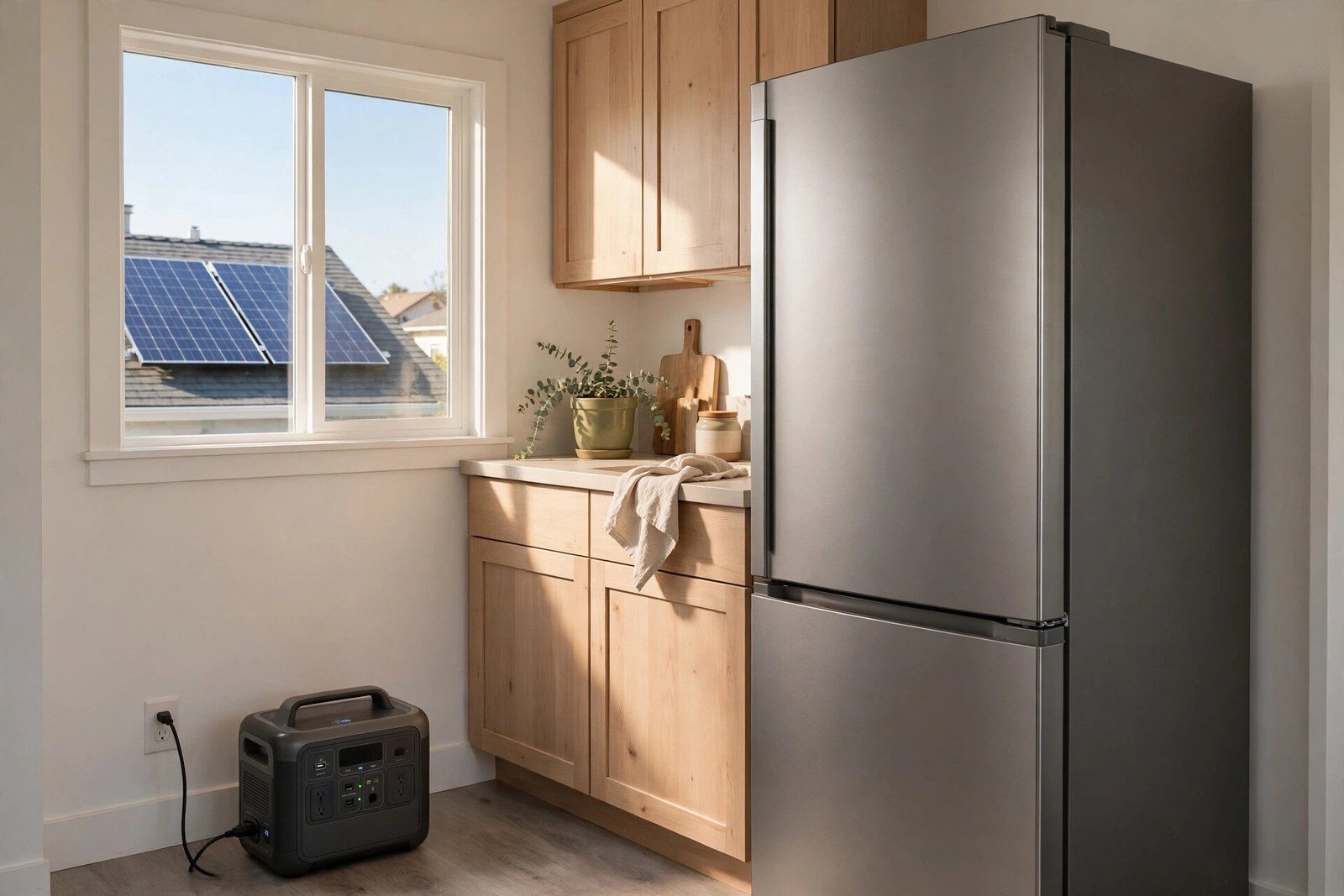
For a typical full size refrigerator, plan on 400W to 600W of solar panels: that is two to three 200W panels, or four to six 100W panels.
A mini fridge needs far less, often a single 200W panel. The exact count comes from one number, your fridge daily energy use, and this guide shows how to find it and run the calculation in about five minutes.
The Short Answer: Panel Counts by Fridge Type
Panel counts only make sense next to daily energy use. Fridges do not draw power evenly all day. The compressor cycles on and off, so what matters is total watt-hours per day, not the watt figure on a spec sheet.
Typical ranges look like this:
- Mini fridge: 550 to 900Wh per day, needs about 200W to 300W of panels
- Apartment or compact fridge: 1,000 to 1,500Wh per day, needs about 300W to 500W of panels
- Full size family fridge: 1,500 to 2,000Wh per day, needs about 400W to 600W of panels
- Older or garage fridge: 2,000Wh per day or more, needs 600W of panels and up
These figures assume about 4 to 5 peak sun hours and include headroom for losses. A fridge in a hot garage, opened often, sits at the top of its range or above it. The steps below replace these estimates with your own fridge number.
Step 1: Find Your Fridge Daily Watt-Hours From the EnergyGuide Label
Most fridges carry a yellow EnergyGuide label, on the fridge in the store or in the manual and product listing online. It shows estimated yearly electricity use in kWh.
Divide that yearly figure by 365. That is your daily use.
Worked examples:
- 400 kWh per year divided by 365 equals about 1,100Wh per day
- 550 kWh per year divided by 365 equals about 1,500Wh per day
- 700 kWh per year divided by 365 equals about 1,900Wh per day
No label? Use the typical ranges in the section above and size to the top of the range. A plug-in energy meter gives the most accurate answer of all. Run the fridge through it for 24 to 48 hours and use the measured daily total.
One warning: do not size from the nameplate amps and volts inside the door. That product gives the draw while the compressor runs. It says nothing about how many hours the compressor actually runs, and sizing from it overshoots the panel count badly.
Step 2: What One Panel Actually Produces Per Day
A panel rating is its output under ideal test conditions at noon on a perfect day. Real daily production is lower.
A useful planning estimate:
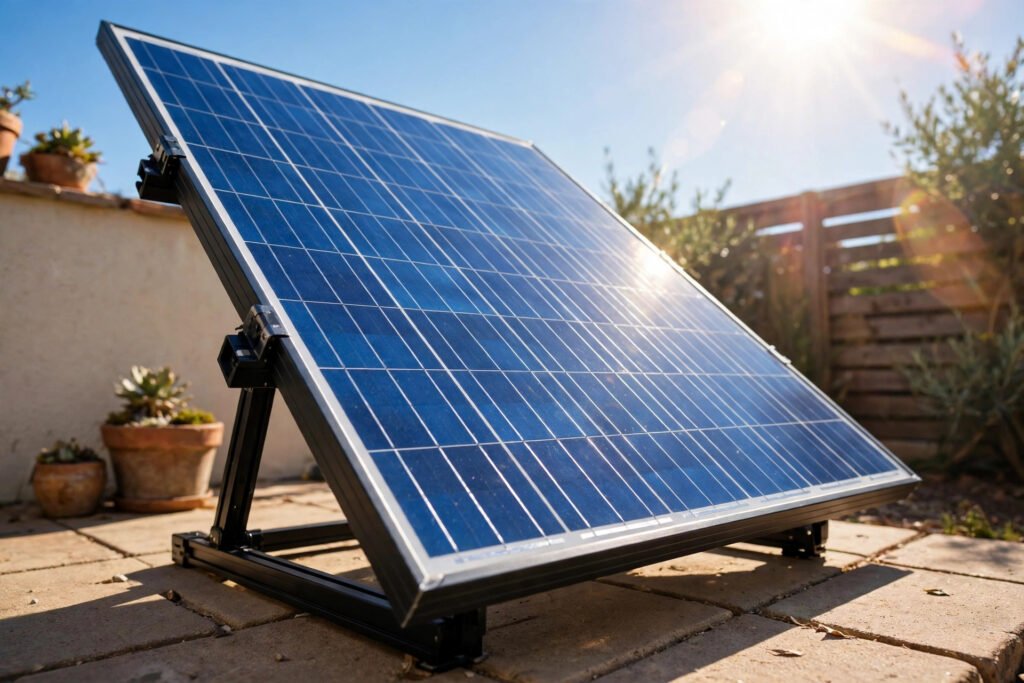
- One 100W panel produces about 400 to 500Wh on a good sun day
- One 200W panel produces about 800 to 1,000Wh on a good sun day
The formula behind those numbers: panel watts times peak sun hours times 0.75 to 0.80. The last factor covers real losses: panel angle, heat, wiring, and the charge controller.
Peak sun hours are not daylight hours. Most US locations average 4 to 6 peak sun hours across the year, fewer in winter, more in the desert Southwest. Northern and cloudy regions should plan on 3 to 4. Free tools such as NREL PVWatts give a local estimate by address.
Step 3: The Panel Count Formula, With a Worked Example
The full calculation has three lines:
1. Daily need: fridge Wh per day, from Step 1
2. Daily yield per panel: from Step 2
3. Panels needed: daily need divided by daily yield, rounded up, plus 20 to 30 percent headroom
Worked example, full size fridge:
- Daily need: 1,500Wh
- Yield per 100W panel: 450Wh
- 1,500 divided by 450 equals 3.3, so 4 panels before headroom
- With headroom for cloudy days: 4 to 5 panels of 100W, or 2 to 3 panels of 200W
In winter sun of 3 peak hours, the same fridge needs roughly double the summer panel count to break even every day. Most small systems accept a winter deficit and cover it with a bigger battery, grid charging, or both. A later section returns to this point.
Panel Counts by Fridge Type and Sun Hours
Use this table as a cross-check on your own calculation. Figures use 200W panels and include loss headroom.
- Mini fridge, 700Wh per day: 1 panel at 5 sun hours, 1 to 2 panels at 3.5 sun hours
- Compact fridge, 1,250Wh per day: 2 panels at 5 sun hours, 2 to 3 panels at 3.5 sun hours
- Full size fridge, 1,750Wh per day: 2 to 3 panels at 5 sun hours, 3 to 4 panels at 3.5 sun hours
- Older fridge, 2,200Wh per day: 3 panels at 5 sun hours, 4 panels at 3.5 sun hours
If your count lands between two rows, take the higher one. An extra panel costs far less than a system that falls behind every day.
Why You Also Need a Battery: Panels Do Not Run a Fridge at Night
Panels produce nothing after sunset, and a fridge runs around the clock. Every practical fridge setup pairs panels with a battery, usually inside a portable power station or a small battery bank.
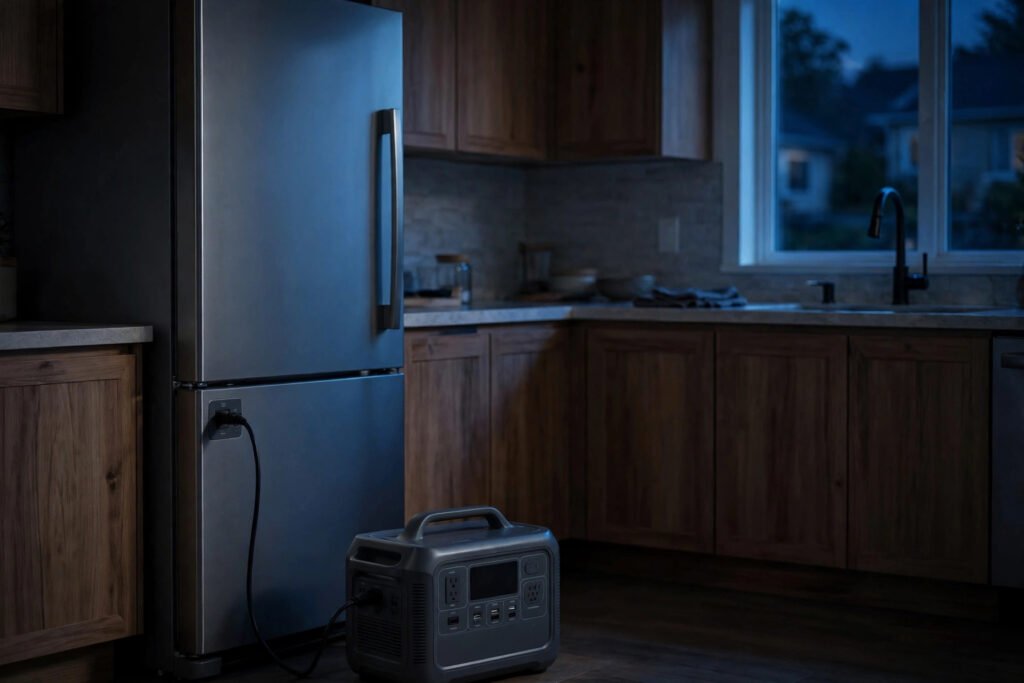
Battery sizing follows its own simple rule. For one full day of fridge backup with no sun at all, the battery needs the fridge full daily Wh, plus margin. For the 1,500Wh per day fridge, that means a 2,000Wh class station in practice, because only about 85 percent of rated capacity is usable after inverter losses.
The panels then have one job: replace each day what the fridge used, so the battery starts every evening full. That is the relationship the panel count protects. Too few panels, and the battery loses ground daily even in sunny weather.
Surge matters too. A fridge compressor draws a brief starting surge, often two to three times its running draw. The power station or inverter must rate above that surge or the fridge will not start, however large the battery is.
Size for Your Worst Month, Not Your Best Day
A system sized on June production runs a deficit in December. Day length, sun angle, and weather all cut winter yield, in northern states by a third or more.
Three honest options:
- Oversize the panels: cheapest per watt, and panels are the least expensive part of a small system
- Add grid charging: let the station top up from a wall outlet in winter, and treat solar as the main source in better months
- Accept seasonal limits: run the fridge on solar in spring through fall, and plan outages differently in winter
What does not work is pretending the June number holds all year. Any guide that skips the worst month is selling panels, not sizing a system.
Common Sizing Mistakes
- Sizing from running watts: Compressor running watts describe an instant, not a day. Daily watt-hours decide panel count.
- Forgetting the battery: Panels alone leave the fridge off all night.
- Ignoring surge: A station can hold enough energy and still fail to start the compressor.
- No headroom: A system sized to exactly 100 percent of need falls behind on the first cloudy day.
- Copying a panel count from a different climate: Three panels in Arizona and three panels in Seattle are different systems.
Choosing Panel Size: 100W, 200W, or 400W Panels
The total watts decide production. The panel size decides practicality.
100W panels suit renters and portable setups. They are light, cheap to replace, and easy to angle on a balcony or patio. Their cost is wiring and space: five of them need five mounts and more cable.
200W panels are the small home sweet spot. Two or three cover most fridges, they are still one person portable in folding form, and rigid versions mount cleanly on a small roof or frame.
400W residential panels give the lowest cost per watt and the fewest connections. They are also large and heavy, built for fixed mounting. On a roof they are the obvious choice. On a balcony they are usually the wrong one.
One rule applies to every size: the station or charge controller solar input limit caps what the array can deliver. Check that limit before adding panels. Extra panels beyond the input cap add morning and evening production, but their noon output is clipped.
Two More Worked Examples
Mini fridge, apartment dweller:
- Daily use: 700Wh
- Yield per 200W panel at 4.5 sun hours: about 700Wh
- Count: 1 panel breaks even in good sun, 2 panels give real headroom
- Battery pairing: a 1,000Wh station holds more than a full day of this fridge
Older fridge, family home:
- Daily use: 2,200Wh
- Yield per 200W panel at 4 sun hours: about 640Wh
- Count: 2,200 divided by 640 equals 3.4, so 4 panels, and 5 with winter headroom
- Battery pairing: a 3,000Wh class station, or 2,000Wh with daily solar refill, because this fridge eats a small battery before morning
The pattern holds at every size: the fridge daily number drives everything, and guessing it is the only expensive mistake.
Frequently Asked Questions
Can a 200W solar panel run a fridge on its own?
Not a full size fridge, day after day. A 200W panel harvests roughly 800 to 1,000Wh on a good day, about half to two thirds of a typical fridge daily use. Paired with a battery it stretches backup through a short outage. Two 200W panels are the honest minimum for most full size fridges.
How many solar panels to run a refrigerator and freezer together?
A fridge freezer combined unit is what the full size figures in this guide already describe, since most household fridges include a freezer section. A separate chest freezer adds roughly 800 to 1,200Wh per day, which adds about one to two 200W panels.
Will 400W of solar run a fridge in winter?
In a mild, sunny winter climate, close to yes for an efficient fridge. In a northern winter at 3 peak sun hours, 400W yields about 900Wh per day, short of a typical 1,500Wh fridge. Add panels, grid charging, or accept a partial contribution.
What size power station pairs with 400W of panels for a fridge?
A 2,000Wh class station is the practical match. It holds more than a day of fridge energy, and 400W of panels can refill most of a day use in good sun. Check that its surge rating clears the fridge compressor start.
Do I need an inverter for a solar powered fridge?
Yes, unless the fridge is a 12V DC model built for vehicles or off grid use. Household fridges run on AC power, so the battery output passes through an inverter. That conversion is why this guide counts only 85 percent of battery capacity as usable.
How These Numbers Were Checked
Fridge consumption ranges follow EnergyGuide style yearly ratings divided by 365. Panel yield uses the standard planning formula, panel watts times peak sun hours times a 0.75 to 0.80 real world factor.
All figures are planning estimates. Your fridge label and your local sun hours replace every estimate here with a better number.
This guide is part of our Solar Power for Small Homes hub, with sizing calculators and apartment backup guides.