

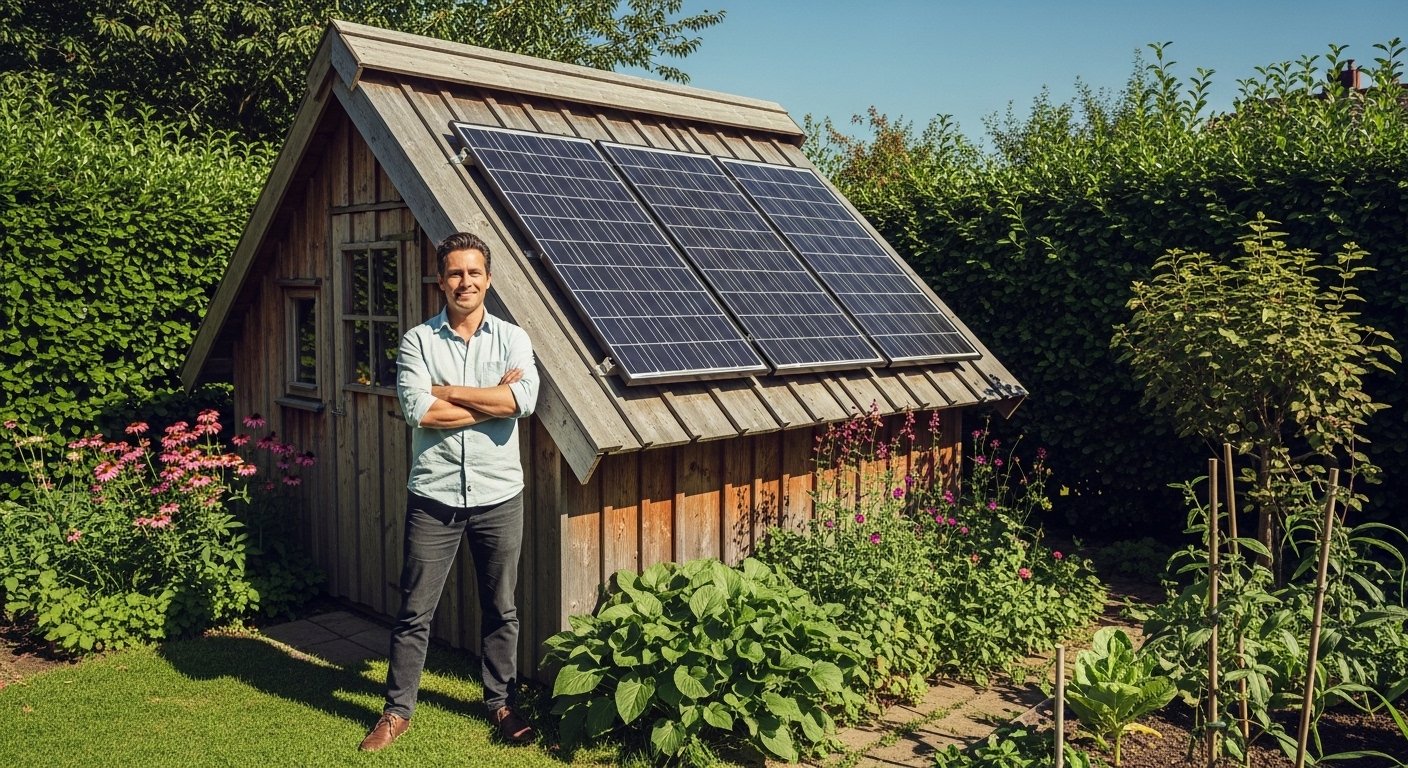
Imagine flipping a switch inside your shadowy backyard shed, not fumbling for a dusty lantern or tripping over endless extension cords.
Picture crisp LED light flooding your workspace, power tools humming reliably, or a security camera silently keeping watch, all fueled purely by the sun. Turning this vision into reality begins with a crucial step: securely mounting your solar panel.
Welcome to your DIY journey! Whether you envision sleek panels angled perfectly on your shed roof or a sturdy diy solar panel ground mount nestled nearby, this guide is your blueprint.
We’ll navigate the essentials, including choosing between a simple DIY wood solar panel mount for affordability, a DIY adjustable solar panel mount for optimal seasonal tilt, or robust DIY solar panel mounts for a permanent racking system.
Forget worries about a leaky roof or unstable brackets; we focus on smarter, safer, code-conscious approaches for installing solar panels on your shed or as diy ground-mounted solar panels.
Ready to unlock true off-grid freedom and savings? Let’s build your small-scale solar power success story, safely and smartly, one secure clamp at a time. Your empowered, sun-drenched shed awaits.
Table of contents
What is Diy Solar Panel Mounting?
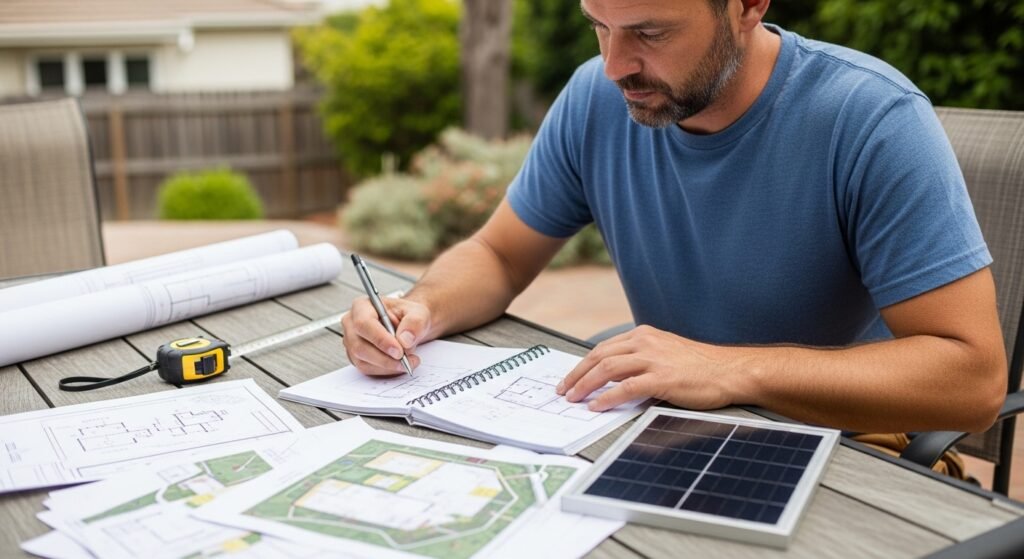
Amir stared at his high electricity bill and then glanced at the sun-drenched yard. It was time for a change. He decided to embrace solar power with a DIY approach. Instead of buying a costly commercial racking system, he delved into the world of DIY solar panel mounting.
This is the art of creating your own custom structure to securely mount each solar panel. While some brave the roof, Amir worried about causing a leak, so he chose to build diy ground-mounted solar panels.
He sketched out plans for a sturdy diy solar panel ground mount using treated lumber, creating a diy wood solar panel mount. This custom mounting system allowed him to set the perfect tilt for maximum sun exposure. He learned how each bracket and clamp worked, carefully crafting a rack that would withstand the elements.
This diy solar panel mount project wasn’t just about saving money; it was about building his own solar system from the ground up and taking control of his energy future. The satisfaction of seeing his panels mounted on his creation was immense as he prepared to install solar panels himself.
What is the 120 Rule for Solar Panels?
Leo, a DIY enthusiast, was starting his DIY solar project: a set of DIY ground-mounted solar panels. Having built a system for his RV, he was now designing a diy solar panel ground mount.
His solar panel ground-mount DIY plan included a custom wood solar panel mount and a unique adjustable solar panel mount. As he prepared the mounting system and racking system to install solar panels, an electrician friend shared a critical safety rule.
“Before you finish installing solar,” she said, “you must understand the 120 Rule for your solar system.” She explained that your home’s electrical panel is like a bridge with a strict weight limit. The combined electrical traffic from your new solar power PV system and the utility grid cannot exceed 120% of the panel’s rated capacity.
This rule is essential for any DIY solar panel mounting project, whether it involves a solar panel pole mount or a large ground mount. Leo looked at his diy solar panel mounts, the rack, the bracket, the clamp, and the tilt for each solar panel mount. He realized that preventing an overload was more important than avoiding a roof leak.
Phase 1: Planning & Preparation (The Foundation)
A successful solar installation begins long before the first mounting bracket is secured. This foundational phase determines system efficiency, safety, and longevity. For your shed-based solar energy project, meticulous assessment and planning are paramount.
A. Assessing Your Shed & Site: Know Your Battlefield
- Roof Structure Audit:
- Material & Condition: Identify existing roofing material (asphalt shingle, corrugated metal, wood shake). Critically assess age and integrity. Degraded roofs necessitate repair before installation.
- Load-Bearing Capacity: Crucial. Determine if the roof framing (rafters/joists) can support the added weight of PV panels, mounts, snow, and wind loads. Locate and measure the rafter/joist spacing (typically 16″ or 24″ on-center) – this dictates the placement of the mounting bracket.
- Roof Pitch & Orientation:
- Pitch: Measure the roof angle (rise over run). This directly influences the optimal solar panel mounting tilt angle for maximum annual yield. Steeper pitches may suffice; shallow pitches benefit from tilt kits.
- Orientation: Determine the roof face’s cardinal direction (use a compass or an app). South-facing is optimal in the Northern Hemisphere for capturing peak solar energy. East/West faces yield less but can be viable.
- Shade Analysis: Identify obstructions (such as trees, buildings, and chimneys) that cast shadows. Track their impact across different seasons and times of day (Sun Seeker app is excellent; manual observation over several days works). Even partial shading significantly reduces solar array output.
- Ground Mount Option: If the roof is unsuitable (poor condition, insufficient load, excessive shade, or undesired penetration), evaluate a ground-mount solar system:
- Space: Sufficient clear, unshaded area near the shed.
- Soil Conditions: Soil type (sand, clay, rock) affects footing depth and type (concrete piers vs. driven posts).
- Proximity: Minimize costly wire runs between the ground mount system and shed electrical entry point.
B. Defining Your Solar Needs: Sizing Your System
- Power Requirements (Watt-Hours/Day):
- List all devices/appliances (LED lights, phone charger, small fan, occasional power tool) and their Wattage.
- Estimate daily usage hours per device.
- Calculate:
Device Watts x Hours Used = Watt-Hours (Wh) per device per day. - Sum all device Wh/day for Total Daily Energy Consumption. Add a 20-25% buffer for inefficiencies and future expansion.
- System Sizing (Approximation):
- Use your Total Daily Energy Consumption (Wh) to size key components:
- Solar Panel Wattage:
(Daily Wh / Peak Sun Hours) x 1.4(Peak Sun Hours vary by location, ~3-6 hrs; 1.4 accounts for losses). - Battery Capacity (Amp-Hours – Ah):
(Daily Wh / System Voltage) x Days of Autonomy / Depth of Discharge(e.g., 12V system, 2 days backup, 50% DoD). This defines your storage needs. - Remember the core components: PV Panels • Charge Controller • Battery Bank • Inverter (if AC power is required).
C. Choosing Your Mounting System: Secure & Optimized
The choice of DIY solar panel mounting system hinges on site assessment and specific needs.
- Roof Mount Types:
- Flush Mounts: Panels sit parallel to the roof surface.
- Pros: Low profile, aerodynamic, minimal wind load, simpler installation.
- Cons: Suboptimal tilt angle reduces yield (especially on low-pitch roofs), and there is potential heat buildup underneath.
- Tilted Mounts (Rails/Kits): Use rails and adjustable legs/brackets to set a fixed optimal tilt angle.
- Pros: Significantly increased energy production (10-25%+), better self-cleaning, improved airflow cooling.
- Cons: Higher profile, increased wind loading, more complex installation, higher cost.
- Corner Brackets/Z-Brackets: Attach directly to panel frame corners, often bolted to rafters.
- Pros: Simple, low-cost for small arrays (1-2 panels).
- Cons: Less structural rigidity for larger arrays, limited adjustability, potential for stress points.
- Ground Mount Types (Key for DIY Ground Mounted Solar Panels):
- Pole Mounts: Single sturdy pole (steel pipe) set in concrete, with tilt-adjustable frame holding panels. Ideal for DIY solar panel pole mounts for 1-4 panels.
- Fixed-Tilt Racks: Multiple posts driven or set in concrete, supporting a fixed-angle frame. Scalable for larger solar arrays. Simpler and cheaper than tracking.
- Tracking Mounts (Briefly): Automatically follow the sun (single or dual-axis). Pros: Maximum energy harvest (25-45%+ gain). Cons: High cost, complexity, maintenance, and overall lack of cost-effectiveness for small shed systems.
- Material Considerations:
- Aluminum: Lightweight, highly corrosion-resistant, easier to handle. Standard for most solar mounting kits. Ensure adequate strength for local wind/snow loads.
- Galvanized Steel: Stronger and heavier, excellent durability, often used in ground mount system frameworks. Ensure hot-dip galvanization for longevity.
- Compatibility: Choose mounts specifically designed for your roof type (e.g., composite shingle hooks, metal roof clamps) or ground mount system suitable for soil conditions.
D. Gathering Tools & Materials: Be Prepared
Procure quality components from reputable solar panel kit suppliers or specialized vendors.
- Essential Tools:
- Drill/Driver & Impact Driver, Measuring Tape, Level (4ft+), Socket/Wrench Set, Wire Strippers/Crimpers, Multimeter.
- Heavy-Duty Ladder, Safety Gear (Gloves, Safety Glasses, Roof Harness & Anchor if roof mounting!), Hole Saw Kit, Caulk Gun.
- Mounting Hardware Kit: Rails (if applicable), End Clamps, Mid Clamps, L-Feet/Standoffs, Flashing (roof penetrations), Stainless Steel/Galvanized Bolts/Nuts/Washers. Ensure compatibility with your chosen PV panel frame.
- Electrical Components:
- PV Panels: Monocrystalline or Polycrystalline, matching voltage.
- Wiring: UL-rated PV Wire (Sunlight Resistant, USE-2 or PV Wire), Conduit (EMT or LFNC for protection), MC4 Connectors (tools), Grounding Wire (#6 or #8 AWG bare copper) & Lugs, Weatherproof Junction Boxes, Cable Clips/Ties.
- Roof Penetration Sealing: High-quality, roof-compatible sealant (Polyurethane or Butyl-based). Never rely solely on silicone!
- Ground Mount Specific:
- Concrete Mix (Quick-setting), Post-Hole Digger (manual or powered), Gravel (for drainage), Mounting Posts/Poles & Frame Components specific to your ground-mount solar system design.
This rigorous planning phase is the bedrock of a safe, efficient, and enduring solar panel installation. Investing time here prevents costly mistakes and ensures your shed solar array delivers reliable, clean energy for years
Phase 2: Installation – Mounting the Hardware
With your blueprints in hand, the moment arrives to bring your vision DIY solar panel mounting system to life. This is the most critical phase of yourDIY solar installation, where meticulous work ensures you energy system will be safe, secure, and productive for decades. A professional solar installer prides themselves on the quality of their mounting, and so should you. Let’s walk through the installation process.
A. Safety First: The Non-Negotiable Rules
Before a single tool is lifted, internalize these safety protocols. The goal is to keep install your solar panels without incident. Cutting corners here can have catastrophic consequences, far outweighing any savings on the solar panel cost.
- Height Safety: When putting
panels on the roofAlways use a properly secured ladder. A personal fall arrest system (harness and lanyard) is essential. Work with a spotter on the ground, and never work in wet, icy, or windy conditions. - Electrical Safety: Even though the panels are not yet connected to your main system, they can generate a live DC current in sunlight. Cover the panels with an opaque blanket until you are ready to wire them. Always use insulated tools, and ensure all power sources are completely disconnected and locked out.
B. Roof Mount Installation: The Skyscraper on Your Shed
For a rooftop solar panel system, the roof itself becomes your foundation. Each step is critical to ensure structural integrity and prevent leaks.
- Locating Rafters: This is the most crucial step. Use a high-quality electronic stud finder to locate the center of each roof rafter where you plan to place
roof attachments. Your rafters are the skeleton of the roof; attaching to them is the only way to ensure your array can withstandhigh windssnow loads. Double-check your marks by measuring from a known edge. - Positioning Mounting Points: Lay out your mounting points based on your plan. Ensure you leave adequate spacing between panels for airflow (which keeps panels cooler and more efficient) and for the mid-clamps and end-clamps that will hold them.
- Installing Flashing: Never drill directly through your shingles. To create a waterproof seal, you must use flashing. For each mounting point, carefully lift the shingle and slide a flashing plate (like those from a reputable brand
Ironridge) underneath it. The flashing should be integrated with the shingle layers so that water sheds over and around it. - Attaching Mounting Feet: Drill a pilot hole through the flashing and sheathing directly into the center of the rafter below. Fill the pilot hole with a high-quality roofing sealant, then drive your lag bolt through the L-foot or mount, securing it firmly in place against the rafter. The sealant will squeeze out, creating a durable, watertight gasket.
- Installing Rails: With your L-feet securely attached, you can now install
installthe rails. These rails form theracking systemthat the panels will sit on. Bolt them loosely to the L-feet, use a level to ensure they are perfectly parallel and level, and then tighten all connections to the manufacturer’s specified torque values.
C. Ground Mount Installation: The Ground-Up Approach
If you’ve opted for diy ground mounted solar panels, the process is more like building a deck than working on a roof.
- Site Preparation: Begin by clearing and leveling the designated area. Remove all vegetation and topsoil, and lay down a weed barrier and a layer of gravel to ensure proper drainage and prevent future growth.
- Setting Posts/Footings: This provides the anchor against frost heave and wind. Dig holes for your vertical posts to a depth that is below your local frost line. Place the posts in the holes, use a level to ensure they are perfectly plumb, and fill the holes with concrete. For a faster
DIY solar panel installation, ground screws can be a viable, though more expensive, alternative. - Assembling the Frame: Once the footings have cured, you can assemble the rack. Attach the horizontal and diagonal supports to your vertical posts, creating the rigid frame that will hold the panels. Use heavy-duty, corrosion-resistant bolts, and double-check that the entire structure is square and secure before moving on to mounting the panels and connecting your
monitoring systems
Phase 3: Mounting the Panels & Wiring
Once the firm foundation is in place, whether it’s anchored by a solid support or secured to the rafters, you’ve arrived at the exciting final, transformative stage.
This is where glass and silicon meet steel, and your array begins to look like a true solar power system. Precision and safety are paramount during this phase for the longevity and performance of your entire system.
A. Panel Handling & Placement
A solar panel is a durable but delicate piece of equipment. Its glass surface can be scratched, and the frame can be bent if mishandled. Always handle panels with care:
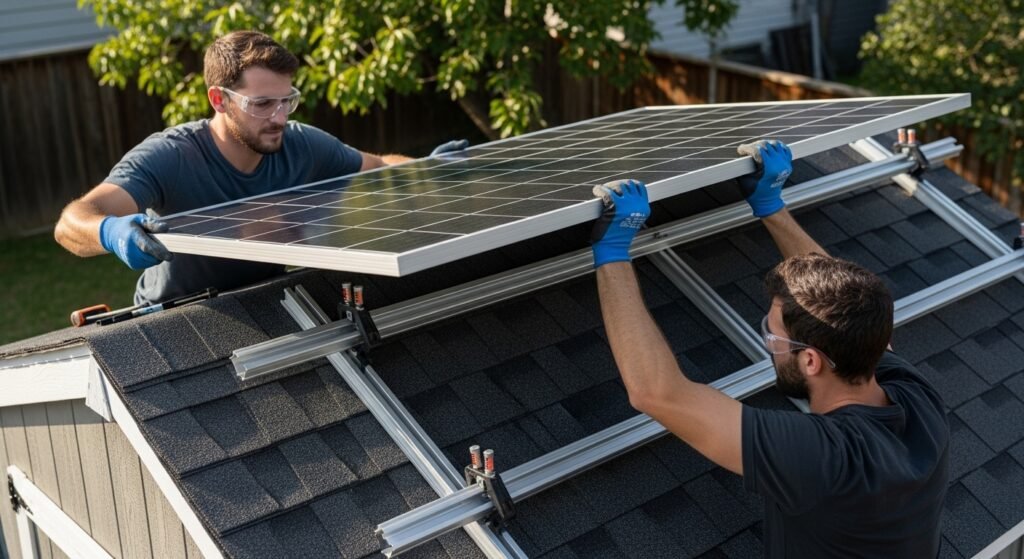
- Safe Lifting: This is a two-person job, minimum. Wear sturdy gloves for grip and protection. Lift from the frame sides, never applying pressure to the panel surface.
- Positioning: Carefully place each panel onto the rails of your
DIY solar panel mounting system. Gently slide it into its planned position, ensuring the frame’s pre-drilledmounting holesalign with the clamping areas of the rails.
B. Securing Panels to the Mounts
This is the mechanical heart of the racking and mounting process. Using the correct clamps and torque ensures the panels are secure without creating dangerous stress points.
- Mid-Clamps and End-Clamps: Use end-clamps for the panels at the beginning and end of each row. Use mid-clamps for the shared space between two panels. These specialized clamps slide into the rail channels and are designed to securely hold the panel frames.
- Proper Torque: This is critical. Over-tightening a clamp can create a micro-crack in the panel’s glass, leading to premature failure. Under-tightening can cause a panel to become loose or dislodge in high winds. Use a torque wrench set to the manufacturer’s specifications to ensure every clamp applies the perfect amount of pressure.
C. Running Conduit & Wiring
Now, you’ll create the electrical pathway from your array to your shed. A tidy, well-protected wiring job is the hallmark of a quality installation, helping to reduce long-term maintenance and improve overall performance.
- Plan the Route: Determine the cleanest, most direct path for your conduit from the panels to the entry point in your shed. Avoid sharp bends and minimize exposure to physical damage.
- Install Conduit: Securely fasten Electrical Metallic Tubing (EMT) or Liquid-tight Flexible Non-metallic Conduit (LFNC) along your planned route using appropriate straps. This protects the PV wires from UV degradation and physical damage.
- Pull PV Wire: Carefully pull the red (+) and black (-) UL-rated PV wires through the conduit. Leave a “service loop,” a small, neat coil of extra wire, near the panels. This provides slack for any future servicing without requiring the entire wire to be re-run.
- Make MC4 Connections: This is where you create your panel strings. Based on your
solar calculatordesign, connect the panels in series (+ to -) or parallel (+ to +, – to -) using the attached MC4 connectors. You must hear an audible “click” to confirm the connection is secure and weatherproof. Double-check all polarity before proceeding.
D. Grounding the System
This is the most important safety step in your entire project. Grounding provides a safe path for stray electricity to travel to the earth, protecting both your equipment and anyone who comes into contact with the system. Failure to ground properly is dangerous and will not pass inspection by local authorities.
- Bonding: Every metallic component of the system must be electrically bonded together. This includes every panel frame and every piece of the
mounting structure. Use grounding lugs and clips specifically designed for this purpose. - Grounding Conductor: Run a continuous bare copper or green-insulated grounding conductor, connecting it to the grounding lug on each panel and rail.
- Grounding Electrode: This conductor must then be connected to a dedicated grounding electrode—typically an 8-foot copper-clad rod driven deep into the earth near your shed. This final connection, made with a proper acorn clamp or lug, ensures your entire
residential solararray is safely tied to the earth.
Phase 4: Entry Point, Sealing & Final Checks
With your panels gleaming in the sun, the final phase of the installation begins. This is where you meticulously connect the external array to your indoor equipment and perform the critical checks that ensure safety, longevity, and performance.
Getting these finishing touches right is what separates a professional-grade residential system from a short-lived project. It guarantees your low installation costs don’t lead to expensive problems down the road.
A. Creating a Watertight Entry Point
Think of this as creating the secure umbilical cord for your power system. The goal is a completely weatherproof transition from the outside in.
- Location is Key: Choose the most protected entry point possible. Directly under a roof eave is ideal as it’s shielded from direct rain. A side wall entry is also a common and effective choice. Avoid low points on the roof where water might pool.
- Use the Right Hardware: Never just drill a hole and push wires through. For a professional seal, use a dedicated weatherproof cable entry gland. This device has a rubber gasket that compresses around the cables, creating a tight seal. Alternatively, for systems running in conduit, an LB conduit body provides a durable, 90-degree turn into the building that is easily sealed.
- Seal Exhaustively: This is not the place to be frugal with sealant. Use a high-quality, UV-stable sealant appropriate for the surface. For roof penetrations, use a flexible roofing sealant. For walls, use 100% silicone caulk. Apply a generous bead around the entry fitting, ensuring there are no gaps, and tool it smooth for a perfect, long-lasting seal.
B. Final System Checks
Before you energize your system, conduct this three-part pre-flight check. This methodical inspection ensures your array is mechanically sound and electrically correct.
1. Mechanical Inspection
Do a physical “walkaround” of your entire installation. For solar panels on your roof, this means getting back up to verify everything. For a diy ground mounted solar panels system built on concrete footings, the process is similar.
- Grab each panel and confirm it is absolutely solid with no wiggle.
- Verify that every single bolt and clamp connecting the panels to the mounting rails is tightened to the manufacturer’s specified torque.
- Check the security of the entire rack, whether it’s a solar panel pole mount DIY or a large fixed array.
- Carefully look beneath the panels to ensure no wires are pinched, stretched, or rubbing against sharp edges of the mounting rails.
2. Electrical Pre-Check
CRITICAL: Perform these checks before connecting the array’s output cables to your charge controller or inverter. Use a multimeter for these tests.
- Open Circuit Voltage (Voc): With the array in full sun, measure the DC voltage across the positive and negative output leads. The reading should be very close to the expected Voc from your panels’ datasheets (e.g., two panels with a 22V Voc each in series should read ~44V). If the voltage is wrong, you have a wiring error.
- Polarity: Confirm that the positive lead reads positive and the negative lead reads negative on your multimeter. Reversing polarity can instantly destroy your electronics.
- Grounding Continuity: Set your multimeter to the continuity setting (it will beep when a connection is made). Touch one probe to a panel frame and the other to your system’s grounding rod. You must hear a beep, confirming a solid safety ground path.
3. Roof Sealant Check
For all the panels on your roof, your final act is one more visual inspection of your waterproofing. Look closely at every penetration the mounting feet and the cable entry point. Ensure the sealant coverage is complete, with no pinholes or gaps. This final glance is your best defense against leaks and is essential for maximizing your system’s lifetime and your long-term solar energy production.
Final Thoughts
You have journeyed from a simple idea to a fully mounted solar array. By meticulously planning, safely building, and rigorously checking your work, you’ve done more than install panels, you’ve built tangible energy independence.
The satisfaction of seeing your creation harness the powerful Punjab sun is immense. If it is a small system for lights or a robust setup for power tools, your solar-powered shed is a testament to your skill and foresight. Enjoy the quiet hum of clean energy, the freedom from the grid, and the bright, self-sufficient future you have built with your own two hands.

Welcome to Homeblesh! I'm a professional content writer with over five years of experience creating well-researched, practical, and reader-focused content for clients on Upwork and Fiverr. Now, I've dedicated my expertise to building Homeblesh, where I share helpful guides, honest recommendations, and actionable tips based on careful research and industry knowledge. My goal is to provide accurate, trustworthy information to help you make informed decisions while delivering clear, useful, and easy-to-understand content.
- Muhammad Imran

- Muhammad Imran

- Muhammad Imran

- Muhammad Imran


