

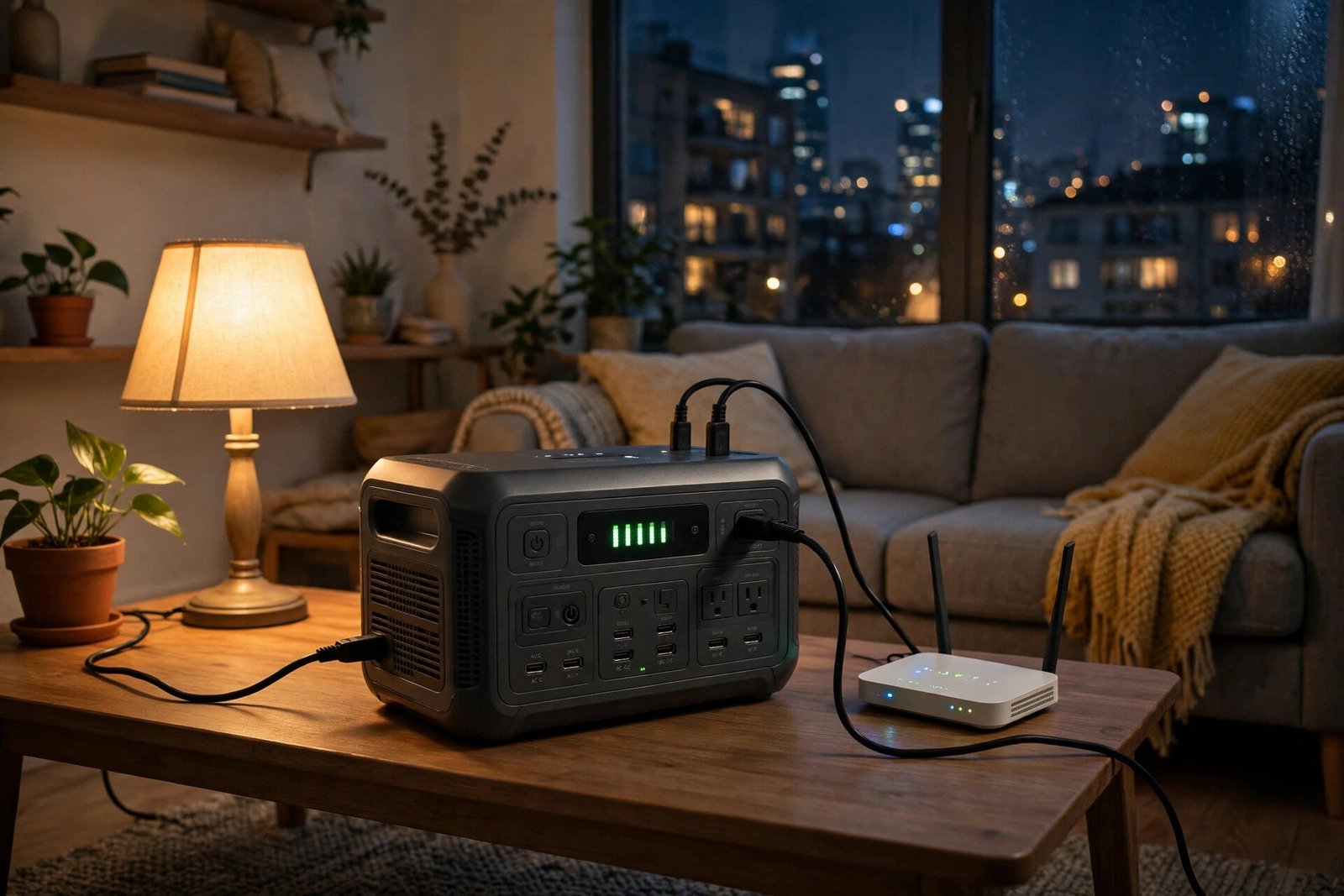
For most apartments, the right size is a 1,000Wh solar generator for essentials, or a 2,000Wh class unit if a refrigerator joins the list. Bigger is not better in a small space: it costs more, weighs more, and stores harder. This guide sizes three real apartment scenarios, watt by watt, so the choice takes about ten minutes.
The Short Answer: Size by Scenario, Not by Square Feet
Apartment size alone tells you almost nothing. Two identical one bedroom flats can need different generators, because one wants lights and internet through an outage and the other wants a fridge and a work laptop for two days.
The three scenarios:
- Essentials only: lights, router, phones, laptop, about 1,000Wh
- Essentials plus refrigerator: about 2,000Wh, with solar recharge strongly advised
- Refrigerator plus working from home: 2,000Wh with 400W of panels, or a 3,000Wh class unit
Each scenario is built out with full numbers below. First, the method behind them, so any apartment list can be sized the same way.
The 5 Step Sizing Method
- List the devices: Write down only what must run in an outage. Wants come later, needs come first.
- Find the watts: Check each device label or manual. For a fridge, use daily energy instead, covered next.
- Multiply by hours: Watts times hours of use equals watt-hours for that device.
- Add losses: Multiply the total by 1.15. Inverters and conversion waste about 15 percent.
- Match the class: Buy the size class at or above the total, and check surge separately.
A note on the fridge: a refrigerator does not run at its rated watts all day. Its compressor cycles. Use its EnergyGuide yearly kWh divided by 365 for daily energy, the same method as our refrigerator panel guide. Using rated watts times 24 hours oversizes the generator by two to three times.
Scenario A: Lights, Router, Phones, Laptop
The goal: stay lit, connected, and reachable through an evening outage.
- Router and modem: 15W for 10 hours equals 150Wh
- 3 LED lights: 30W total for 5 hours equals 150Wh
- Laptop: 60W for 4 hours equals 240Wh
- Phone charging: 2 phones, about 40Wh total
- Total: about 580Wh, times 1.15 for losses equals about 670Wh
Verdict: a 1,000Wh unit covers this with room to spare, and stretches past 10 hours if the laptop is used less. Units in this class weigh about 24 to 28 pounds and store in a closet.
For reference, three current 1,000Wh class models, specs from manufacturer listings checked October 2026:
- EcoFlow DELTA 2: 1,024Wh, 1,800W output, 2,700W surge, 500W max solar input, 3,000 cycles to 80 percent capacity, 27 lb
- Jackery Explorer 1000 v2: 1,070Wh, 1,500W output, 3,000W surge, 400W max solar input, 4,000 cycles to 70 percent capacity, 23.8 lb
- Anker SOLIX C1000: 1,056Wh, 1,800W output, 2,400W surge, 600W max solar input, 3,000 cycles to 80 percent capacity, 28.4 lb
Note the cycle thresholds differ: Jackery rates to 70 percent remaining capacity, EcoFlow and Anker to 80 percent. The numbers are close, but they are not measured to the same line.
Scenario B: Add a Refrigerator
The goal: protect food through a full day outage.
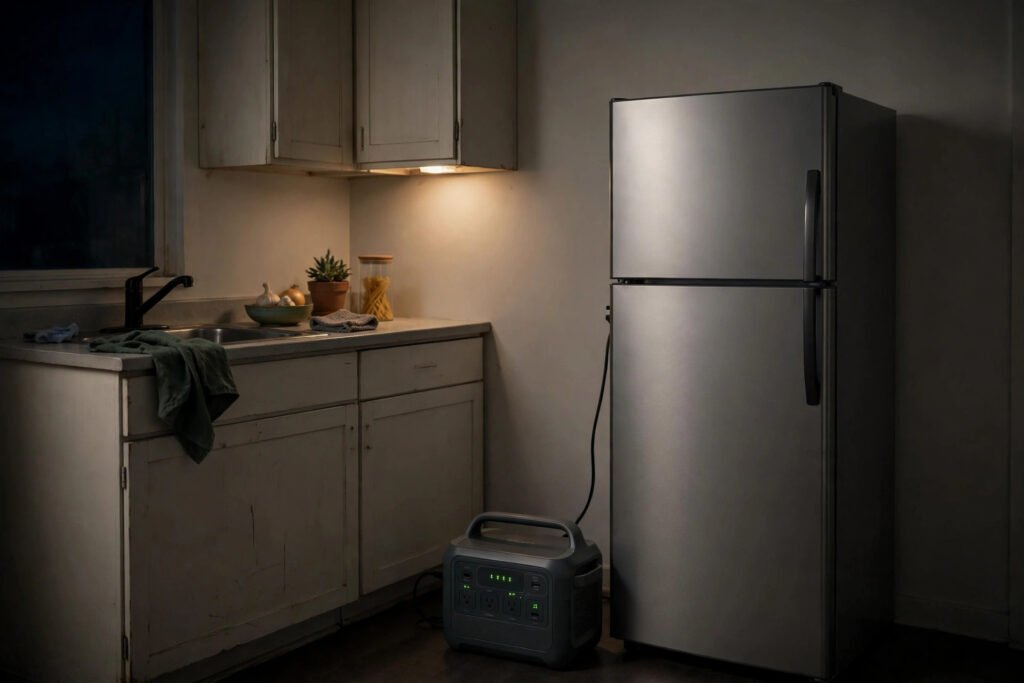
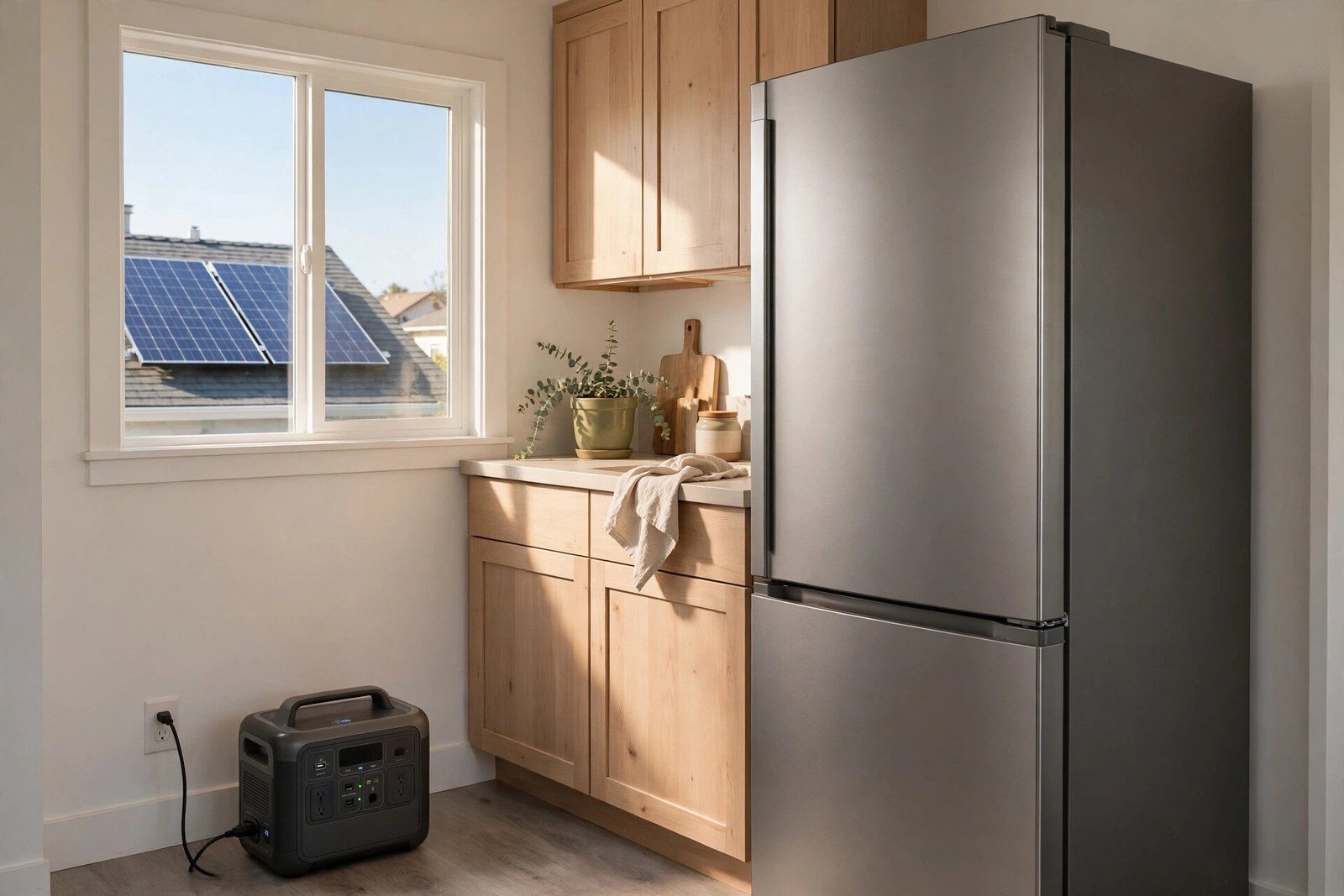
Start from Scenario A at about 670Wh with losses. Add a typical fridge at 1,500Wh per day.
- New total: about 2,170Wh per day
- Battery reality check: only about 85 percent of rated capacity is usable, so a 2,000Wh unit delivers about 1,700Wh
Verdict: a 2,000Wh unit covers roughly one day of fridge plus light essentials if the laptop stays off most of the day. For a comfortable full day, the honest pairing is 2,000Wh plus 200W to 400W of solar panels refilling during daylight. Without recharge, plan on the 3,000Wh class for a full fridge day plus essentials.
Food safety sets the floor here. FoodSafety.gov guidance: a closed refrigerator keeps food cold for about 4 hours without power, and a full freezer holds temperature for about 48 hours. The generator job is to beat that 4 hour clock, which even Scenario A sizing does for the fridge alone if essentials stay minimal.
Scenario C: Refrigerator Plus Working From Home
The goal: a normal workday, fridge protected, through a day long outage.
- Fridge: 1,500Wh per day
- Laptop: 60W for 8 hours equals 480Wh
- Monitor: 30W for 8 hours equals 240Wh
- Router: 15W for 12 hours equals 180Wh
- Lights and phones: about 200Wh
- Total: about 2,600Wh, times 1.15 equals about 3,000Wh
Verdict: this is the scenario where apartments outgrow a single small unit. Two practical builds:
- A 2,000Wh unit plus 400W of balcony or portable panels, refilling roughly 1,200 to 1,600Wh across a good sun day
- A 3,000Wh class expandable unit, heavier at 50 lb plus, which needs a permanent corner rather than a closet
Working from home loads are predictable, so this scenario rewards the panel pairing. The fridge cycles all day while the panels produce, which is the best matched load in this whole guide.
The Surge Check Most Apartment Guides Skip
Capacity decides how long. Output and surge decide whether things start at all.
Fridge compressors and any motor load draw a starting surge, commonly two to three times running watts for a fraction of a second. All three 1,000Wh class models above surge between 2,400W and 3,000W, comfortably above a typical fridge start. Problems appear with smaller 500Wh units and with window air conditioners, whose surge and running draw are both high.
Rule: the unit surge rating must beat the largest single starting load, and its continuous output must beat everything running at the same moment. Check both numbers, not just the big one on the box.
Can You Recharge It on a Balcony: Panel Maths
Panel watts times peak sun hours times 0.75 gives a daily estimate:
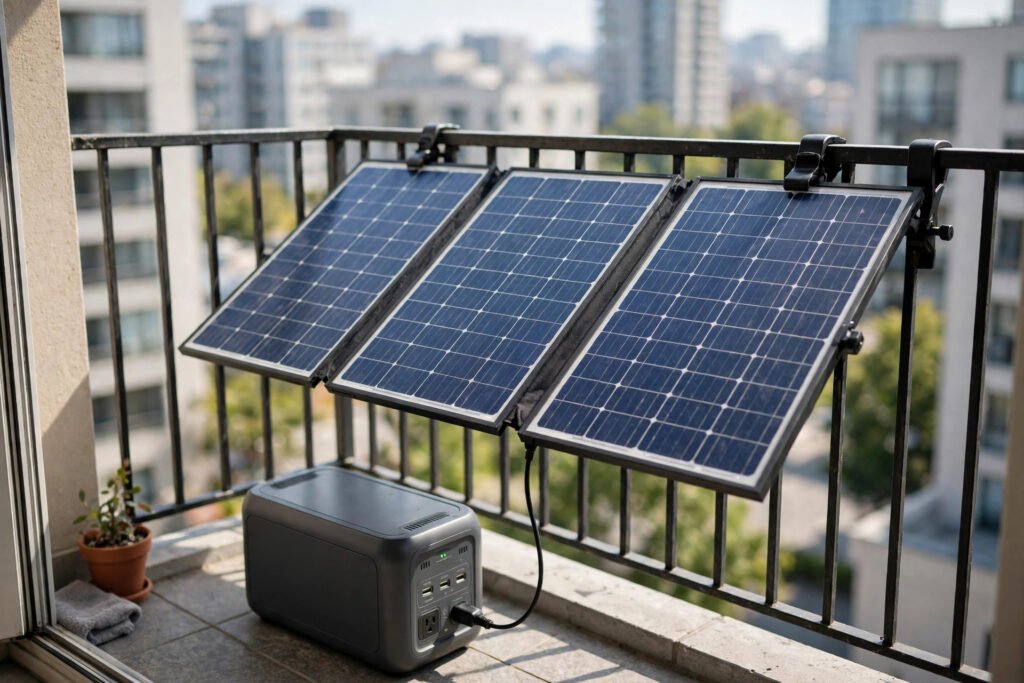
- 100W panel at 4 sun hours: about 300Wh per day
- 200W panel at 4 sun hours: about 600Wh per day
- 400W of panels at 4 sun hours: about 1,200Wh per day
That is enough to matter. A 200W panel covers Scenario A daily use on its own in decent sun. It does not cover a fridge, which is why Scenario B pairs 2,000Wh with panels rather than pretending a panel alone solves it.
Two checks before buying panels for a balcony: the lease and building rules, and the station solar input limit. A 400W array into a station capped at 400W input is fine. The same array into a 200W input cap wastes half its output at noon.
Apartment Rules: Lease, Building, and Indoor Safety Checks
- Lease check: Many leases restrict anything attached to railings or exterior walls. A panel leaned or clamped without fixings is a different conversation from a mounted one. Ask before buying.
- Weight and storage: A 1,000Wh unit at 24 to 28 lb moves easily. A 3,000Wh class unit is a two hand lift and a permanent spot.
- Indoor safety: Battery stations produce no exhaust and are built for indoor use, unlike fuel generators, which must never run indoors. Keep vents clear, keep the unit dry, and do not store it in an exit path.
- Noise: Battery stations are effectively silent apart from fan noise under heavy charge. No neighbour problem at all, which is more than any fuel generator can claim.
- Charging temperature: Current models in this class list charge ranges starting at 0 degrees C, 32 degrees F. A freezing balcony in winter is a charging problem, so charge indoors in cold months.
The Loads That Break Apartment Sizing: AC, Microwave, Kettle
Every apartment plan meets the same three appliances, and each needs a direct answer.
Window air conditioner: a small 5,000 BTU unit draws roughly 450 to 550W while running. On a 1,000Wh unit that is about 1.5 to 1.8 hours of cooling. No 1,000Wh station runs a window AC through a night. Cooling a sleeping room overnight is a 3,000Wh plus conversation, or a different plan entirely, such as cooling one room before bed and using a fan overnight. A fan at 50W runs about 17 hours on the same station. That contrast is the most useful sizing fact in this guide.
Microwave: 800 to 1,200W, but for minutes. Five minutes of reheating costs roughly 70 to 100Wh. Any 1,000Wh class unit in Scenario A handles it easily, and the energy cost is trivial. Short, high power loads are a surge question, not a capacity question.
Electric kettle: 1,000 to 1,500W for about 4 minutes, roughly 80Wh per boil. Same story as the microwave, provided the station continuous output clears the kettle rating. The EcoFlow and Anker models listed above, at 1,800W, clear it. A 1,500W kettle on a 1,500W rated unit is a coin toss, so check both ratings.
Scenario Summary Table
Keep this table as the buying shortcut. All totals include the 1.15 loss factor.
- Essentials only: about 670Wh needed, buy the 1,000Wh class
- Essentials plus fridge, one day: about 2,170Wh needed, buy 2,000Wh plus panels, or the 3,000Wh class
- Fridge plus work from home, one day: about 3,000Wh needed, buy 2,000Wh plus 400W of panels, or a 3,000Wh expandable unit
- CPAP overnight added to any scenario: add about 320Wh for 8 hours at 40W, and prefer a DC adapter to skip inverter losses
If a scenario total lands within 10 percent of a size class limit, step up a class or add panels. Outages do not respect tidy arithmetic, and the fridge always uses more on the hot day the power fails.
Frequently Asked Questions
What size solar generator do I need for an apartment with a fridge?
Plan on the 2,000Wh class plus 200W to 400W of panels, or a 3,000Wh class unit without panels. A fridge alone uses about 1,500Wh per day, and only about 85 percent of a station rated capacity is usable.
Is a 1,000Wh solar generator enough for an apartment?
For essentials, yes: lights, router, phones, and a laptop for an evening and more. It runs a fridge for roughly half a day on its own. It is not a full fridge day solution.
Can I use a solar generator in a rented apartment?
Yes. Nothing is installed and nothing is fixed to the building. The battery unit sits indoors like any appliance. Balcony panels are the only part that touches building rules, so check the lease for those.
How long will a 2,000Wh unit run apartment essentials?
Essentials at about 110W average draw run for roughly 15 hours on 1,700Wh of usable capacity. Add a fridge and the same unit covers about a day of fridge use with light essentials, as Scenario B shows.
Is it worth buying bigger to be safe?
Usually not in an apartment. Oversizing costs money, weight, and storage space, and batteries age whether they are used or not. Size to a scenario in this guide, and prefer an expandable unit if a future move to a house is likely.
How These Numbers Were Checked
Model specifications are from manufacturer product listings checked in October 2026 and are stated with their cycle life thresholds. Runtime and sizing figures are calculations from device wattages shown in each scenario, with a 1.15 loss factor and 85 percent usable capacity. Food safety times follow FoodSafety.gov power outage guidance. Prices are not stated, because they change too often to print honestly.
This guide is part of our Solar Power for Small Homes hub, with panel sizing guides and runtime calculators.
Sponsored · RecommendedSomething worth a look before you goHandpicked for HomeBlesh readers. Tap to explore it.Explore Now
[…] those cases the step up is a 2,000Wh class unit, which roughly doubles every figure in the runtime table, or a 1,000Wh unit with a panel pairing […]