

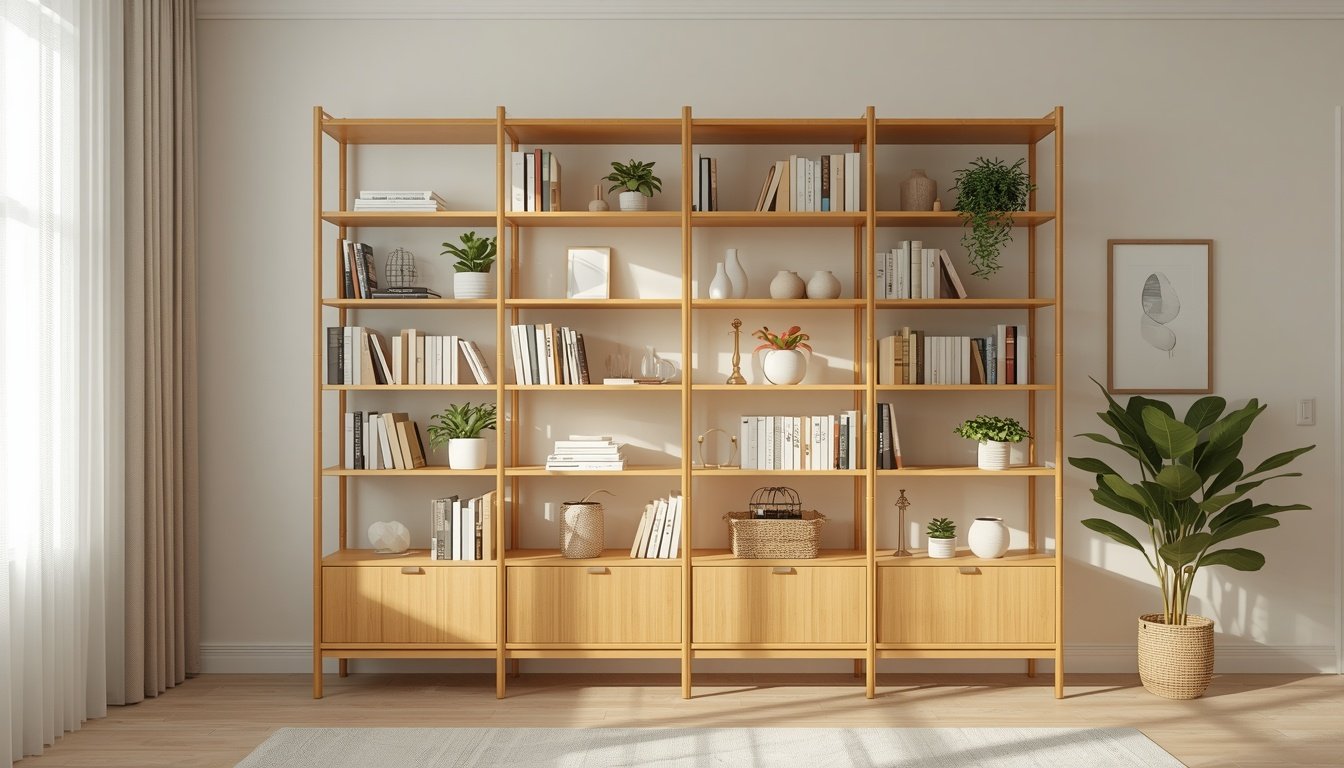
Living in a small apartment often feels like a constant battle against physical constraints. Every square inch is precious, and mass-produced furniture, typically heavy particleboard bookcases or flimsy metal racks, rarely offers the perfect balance of form and function.
For those craving a sophisticated storage solution that respects the limited footprint of modern urban living, the answer lies in a smarter approach to materials and design, a DIY modular bamboo bookshelf.
Unlike traditional plywood pieces that dominate a room, a modular bamboo system offers visual lightness, unmatched structural integrity, and the rare ability to expand or contract as your living arrangements change.
This guide will walk you through the logic of “systems-thinking” in furniture design, teaching you how to move beyond simple assembly to create an adaptable, eco-conscious framework for your home.
Table of Contents
Why Bamboo is the Ultimate Material for Small Bamboo Bookshelf DIYs?

Bamboo has gained immense popularity in contemporary design, but its benefits for apartment dwellers go far beyond its aesthetic appeal. Choosing bamboo is a functional decision that solves the specific spatial dilemmas of high-density living.
The Strength-to-Weight Ratio: Why Bamboo Beats Plywood

Bamboo’s longitudinal fibers provide superior strength, allowing for thinner shelves that won’t sag under heavy loads compared to traditional MDF or plywood.
When building storage solutions, the primary enemy is sagging. Common plywood or MDF components often require thick, bulky dimensions to support the weight of a heavy book collection, which inevitably swallows up your limited floor space.
Bamboo, by contrast, is biologically optimized for vertical stress. Its internal cellular structure, characterized by longitudinal fibers, provides an exceptional strength-to-weight ratio.
A bamboo shelf can carry significant weight while remaining thin, allowing you to maximize vertical storage without adding excessive mass to the room.
Visual Lightness: Reducing “Furniture Bulk” in Tight Quarters
Small spaces thrive on transparency and negative space. Heavy, solid-backed bookcases create “visual noise” that makes a room feel compressed.
A bamboo shelf constructed from poles or slats naturally incorporates gaps, allowing light and air to pass through.
This “visual lightness” prevents your furniture from feeling like a monolithic obstruction, making your small space feel more open, airy, and intentional.
Sustainability: Building an Eco-Friendly Home on a Budget
Sustainability is often sidelined in favor of convenience, but bamboo is the rare material that offers both. As a rapidly renewable grass, it has a significantly smaller carbon footprint than traditional hardwoods or engineered wood products.
By sourcing bamboo, you are investing in a durable, eco-friendly product that rejects the “throwaway culture” of cheap modular furniture. It is a cost-effective, high-impact choice for the conscious creator.
The “Systems-Thinking” Approach: Understanding Modular Design

To build furniture that lasts, you must treat your project as a system rather than a one-off task. A modular approach means every component is designed to interact with others, allowing for infinite expansion.
The Anatomy of a Single Bamboo Module
Think of your bookshelf as a set of standard, repeatable units, ideally a one-foot cube. Each module consists of vertical bamboo supports, horizontal shelf slats, and reinforced cross-bracing.
By standardizing the dimensions, you ensure that any piece you build today will seamlessly integrate with an addition you might construct a year from now.
Scalability: From Nightstands to Floor-to-Ceiling Shelves
Because these modules are standardized, they are inherently scalable. A single module functions perfectly as a minimalist nightstand. Stack three of them, and you have a sleek bookcase.
Align them horizontally to create a low-profile media console. This flexibility ensures your investment in labor and materials serves you regardless of your next apartment’s floor plan.
Future-Proofing Your Furniture: Adapting to Your Next Apartment
The greatest risk in building custom furniture is creating a piece that fits only one specific corner of your current home. By designing in a modular way, you future-proof your storage.
If you move from a studio to a larger apartment, you don’t need to discard your bookshelf; you simply build additional modules or reconfigure existing ones to fit the new spatial layout.
Essential Tools and Materials List
Preparation is the secret to a professional result. Before you begin your bamboo craft project, gather your components and organize your workspace.
Choosing Your Bamboo: Poles, Slats, or Bamboo Dowels
For this system, you will need three types of bamboo:
- Bamboo Poles: For the primary structural vertical supports.
- Bamboo Slats: For the shelf’s horizontal surfaces.
- Bamboo Dowels: For securing joints and adding secondary structural support.
- Bamboo Cylinders: Used as aesthetic and structural spacers between modules.
Hardware and Adhesives: From Superglue to Heavy-Duty Screws
High-strength wood glue is essential for bonding, but hardware ensures longevity. Use high-quality wood screws for the primary structural connections.
For a refined look, incorporate a bamboo trivet or circular bamboo cutouts as decorative end-caps to hide exposed screw heads.
The Maker’s Toolkit: Circular Saws, Electric Drillers, and Speed Squares
You will need a circular saw with a fine-toothed blade to prevent splintering, a reliable electric drill, and a speed square to ensure every corner is perfectly 90 degrees. Accuracy here is non-negotiable for modular alignment.
Safety First: Working with Bamboo Skin and Safety Gloves
Bamboo skin can be sharp, and bamboo sawdust is extremely fine. Always wear safety glasses and a mask when cutting. Heavy-duty work gloves are mandatory to prevent splinters during handling and assembly.
Planning Your Blueprint: Measuring for High-Density Living
Before cutting, visualize your installation. Measure your wall height and the depth of your floor space.
Calculating Vertical Footprints vs. Horizontal Storage
Small-space efficiency depends on capturing vertical real estate. Plan for a floor-to-ceiling configuration to maximize storage volume without sacrificing floor area.
Designing for Your Collection: Sizing for Cookbooks, Chapter Books, and Board Books
Standardize your shelf height based on your items. A 12-inch clearance accommodates most hardcovers, while 8-inch segments are perfect for mass-market paperbacks. Designing with these variables in mind prevents wasted space.
Creating a Cut-List to Minimize Waste
Map out your cuts on paper before touching the saw. Group your cuts by length to minimize scrap and ensure you maximize every inch of your bamboo supply.
Step 1: Prepping the Bamboo Components

Cleaning and Treating the Bamboo Skin
Wipe down all poles with a damp cloth and allow them to acclimate to your apartment’s humidity for 48 hours to prevent warping after assembly.
Precision Cutting: How to Use a Circular Saw without Splintering
To prevent the bamboo from splintering, apply painter’s tape over the cutting line. Cut slowly, allowing the blade speed to do the work rather than forcing the saw through the material.
Pre-Drilling: The Secret to Preventing Bamboo Cracks
Bamboo is a grass with a hollow center and a hard exterior. If you drive a screw directly into it, the material will split longitudinally. Always use a drill bit slightly smaller than the shank of your screw to create a pilot hole. This is the most critical step in maintaining structural integrity.
Step 2: Assembling the Foundation Module

Constructing the Vertical Supports
Connect your main bamboo poles to the side frame. Use a square to maintain a 90-degree angle; even a minor deviation here will prevent your modules from stacking cleanly.
Attaching the Shelf Surfaces using Bamboo Slats
Install your slats across the supports. Ensure they are spaced evenly. If you want a cleaner look, use small bamboo dowels to pin the slats to the supports, then hide them with a dab of wood glue.
Ensuring Structural Integrity with Cross-Bracing
Even if your joints are tight, a bookshelf needs lateral support. Add a diagonal cross-brace of thin bamboo dowels to the back of each module to eliminate wobbling.
Step 3: Mastering the Modular Mechanics

Joining Multiple Units: Temporary vs. Permanent Connections
For a temporary setup, use heavy-duty zip ties hidden behind the frame for a clean look. For permanent installations, use carriage bolts that pass through the vertical poles of adjacent modules, locking them together firmly.
Using Bamboo Cylinders as Stackable Spacers
If you want to create a floating shelf effect, use short segments of bamboo cylinders as vertical spacers between the units. This creates a visual break, adding a custom-designed look to your storage.
Leveling Your Units on Uneven Apartment Floors
Apartment floors are rarely perfectly level. Attach adjustable feet to the bottom of your foundation module. This allows you to raise or lower specific corners to keep the entire system perfectly vertical, even on slanted historic flooring.
Conclusion
Building a DIY modular bamboo bookshelf is more than a weekend project; it is an exercise in intentional, space-saving design. By moving away from the “disposable furniture” mindset and embracing a system built on structural integrity and geometric precision, you transform your apartment into a more efficient, personalized space.
Bamboo offers the perfect combination of resilience, sustainability, and visual elegance. As you progress from your first single module to a fully realized, floor-to-ceiling system, remember that the goal is adaptability.
Whether you are moving to a new city or simply redecorating your current home, this bookshelf system will evolve with you. Start with your measurements, respect the material’s mechanics by pre-drilling every hole.
And enjoy the satisfaction of a custom-built, future-proof home storage solution. With these skills in hand, you have everything needed to reclaim your space and elevate your interior.

Welcome to Homeblesh! I'm a professional content writer with over five years of experience creating well-researched, practical, and reader-focused content for clients on Upwork and Fiverr. Now, I've dedicated my expertise to building Homeblesh, where I share helpful guides, honest recommendations, and actionable tips based on careful research and industry knowledge. My goal is to provide accurate, trustworthy information to help you make informed decisions while delivering clear, useful, and easy-to-understand content.
- Muhammad Imran

- Muhammad Imran

- Muhammad Imran

- Muhammad Imran


