

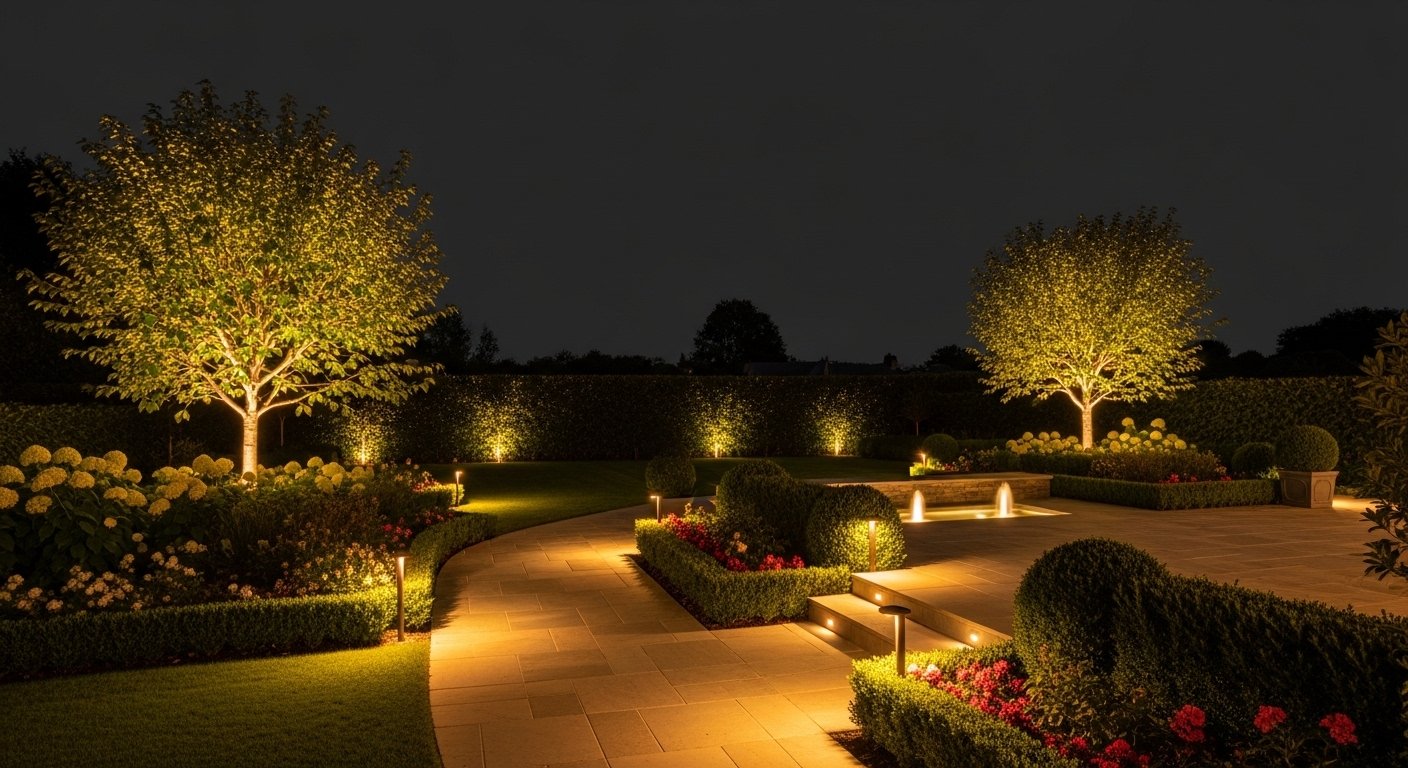
Are you looking for the best Low voltage landscape lighting ideas in 2026. If yes, then you have come to the right place. A well-lit outdoor space does more than improve curb appeal. It creates atmosphere, enhances safety, deters intruders, and allows you to enjoy your garden long after sunset.
Low voltage landscape lighting has become the go-to solution for homeowners worldwide who want beautiful, energy-efficient outdoor lighting without the complexity of full-voltage electrical installations.
Operating on just 12 volts, low voltage lighting systems are safe to install as a DIY project, cost a fraction of traditional systems to run, and offer an enormous range of fixture styles and applications.
If you are lighting a winding garden path, uplighting a statement tree, or adding ambiance to a patio, there is a low voltage solution to suit your vision and budget.
In this guide, we cover the 15 best outdoor low-voltage lighting ideas that will transform your landscape, boost your property value, and create a yard you will want to spend time in every evening.
Table of contents
What Is Low Voltage Landscape Lighting?
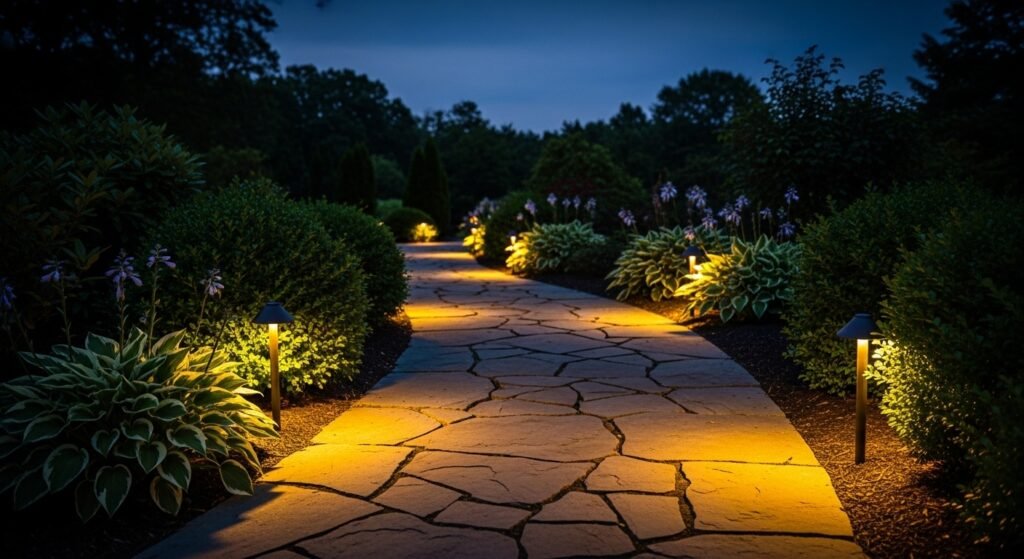
Low voltage landscape lighting refers to outdoor lighting systems that operate at 12 volts rather than the standard 120V (US) or 230V (UK/EU) household current.
A low voltage transformer plugs into a standard outdoor outlet and steps the voltage down to a safe 12V, which then powers all the fixtures connected to the cable run.
Low voltage landscape lighting has become popular for several key reasons. First, it significantly reduces energy consumption compared to mains-voltage systems. Second, the 12V setup minimizes the risk of electrocution, making installation and handling safer.
It allows for easy DIY installation, so most setups do not require a professional electrician. Low-voltage systems are also compatible with modern LED technology, enhancing efficiency.
Today, most low voltage landscape lighting uses 12V LED spotlights and pathway lights, combining the safety and simplicity of low voltage with the exceptional energy efficiency and long lifespan of LED technology.
15 Best Outdoor Low-Voltage Lighting Ideas
1. Classic Garden Path Lighting
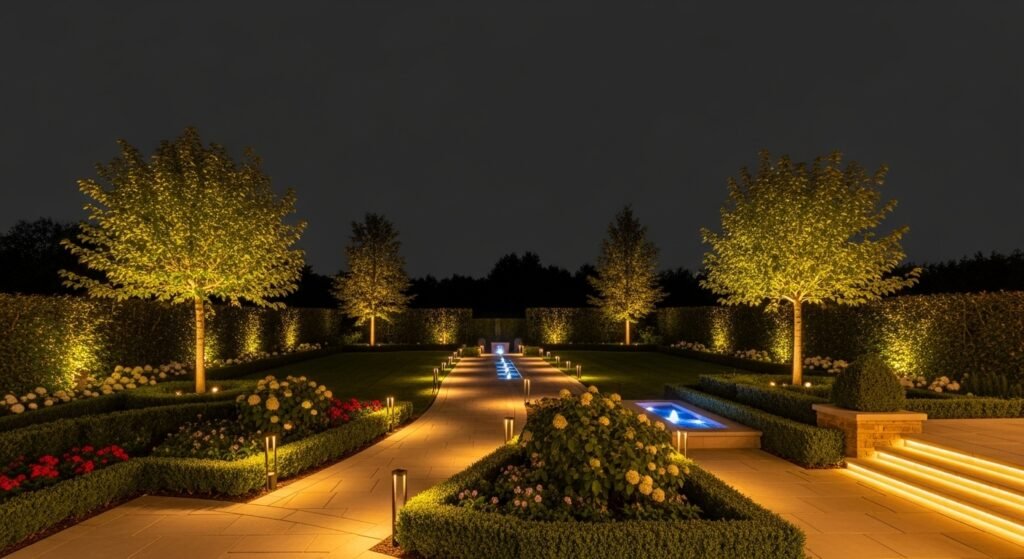
Path lights are the most widely used form of low voltage landscape lighting, and for good reason. Positioned along driveways, garden walkways, and entrance paths, landscape path lights guide visitors safely while creating an elegant lit corridor through your outdoor space.
Traditional pagoda-style path lights spread a soft, downward wash of light across the ground, minimizing glare while maximizing visibility. For a more contemporary look, slim bollard-style path lights cast a clean, directional glow that suits modern architectural gardens.
Space outdoor path lights roughly 6 to 8 feet apart for a balanced, even illumination effect. Staggering them on alternate sides of the path rather than placing them in a straight line on one side creates a more natural, welcoming aesthetic.
2. Uplighting Trees and Specimen Plants
Uplighting trees is one of the most dramatic and visually rewarding applications of low voltage landscape lighting. By placing 12V LED spotlights at the base of a tree and angling them upward, you create striking silhouettes and shadow play that give your garden a resort-like quality after dark.
The technique works especially well on trees with interesting bark textures, multi-stem specimens, palms, ornamental cherries, and large specimen shrubs. Use a warm white colour temperature (2700K to 3000K) for a natural, inviting glow, or experiment with cool white for a more modern, dramatic effect.
For best results, use two or three spotlights positioned at different angles around the base of the tree. This avoids flat, one-dimensional lighting and brings out the three-dimensional form of the canopy and trunk from multiple viewpoints.
3. Downlighting for Moonlight Effect
Where uplighting creates drama, downlighting creates subtlety and romance. Mounting low voltage fixtures high in trees or on elevated structures and directing the light downward mimics the natural effect of moonlight filtering through a canopy.
This technique, often called moonlighting, is particularly beautiful over patios, seating areas, and water features. The soft, dappled shadows created as light passes through leaves produce a living, organic quality that no fixed-position light can replicate.
Use narrow beam angle spotlights and position them at least 15 to 20 feet high for the most convincing moonlight effect. The greater the height, the softer and more diffuse the shadows at ground level.
4. Low Voltage Patio Lighting
Patio lighting transforms an underused outdoor space into an al fresco living room that can be enjoyed throughout the evening. Low voltage options for patio lighting are varied and can be layered for maximum effect.
Recessed deck lights set flush into patio surfaces or steps provide practical ambient light without visual clutter. Wall-mounted fixtures on adjacent fences or garden walls add a vertical element and create a warm, enclosed feeling. Uplighting surrounding planting beds frames the patio space beautifully and extends the sense of the garden into the lit zone.
For dining patios, consider positioning low-level bollard lights around the perimeter to define the space without creating glare at eye level while seated.
5. Step and Staircase Lighting
Outdoor step lights are a critical safety feature for any garden with changes in level, but they also offer tremendous decorative potential. Low voltage LED step lights installed into risers or side walls cast a gentle wash of light across each tread, clearly delineating each step without harsh glare.
Recessed step deck lights are particularly sleek and durable, sitting flush with the surface to avoid trip hazards while delivering reliable, weatherproof illumination. They are available in a wide range of finishes including brass, stainless steel, and matte black to complement any architectural style.
For sweeping stone staircases, try alternating step lights on either side of the staircase for a mirrored symmetry. For narrower garden steps, a single light per riser on one side is sufficient and creates a clean, linear aesthetic.
6. Driveway Edging with Bollard Lights
The driveway is the first impression visitors receive of your home after dark. Edging it with low voltage bollard lights creates a grand, welcoming arrival experience while also providing practical illumination for safe navigation.
Bollard lights are taller and more substantial than standard path lights, making them ideal for wider driveway applications where extra light output is needed. Their vertical form also adds architectural interest, especially when paired with formal planting or neat hedging on either side.
Choose corrosion-resistant materials such as powder-coated aluminium or stainless steel for driveway installations, as they will be exposed to vehicle exhaust, rain, and potential physical contact over time.
7. Garden Bed and Border Lighting
Highlighting planting beds with low voltage landscape lighting adds depth and colour to your garden after dark. Well-placed spotlights angled across low-growing perennials, ornamental grasses, and flowering shrubs create a layered, luxurious landscape that appears entirely different at night than it does by day.
The key to successful garden bed lighting is using lower-wattage fixtures and placing them close to the planting at ground level, rather than using high-output fixtures from a distance. This creates an intimate, immersive quality and avoids washing out the subtler tones of foliage and flowers.
Warm colour temperatures (2700K) complement the natural greens and earth tones of most gardens, while cool whites (4000K+) work better in contemporary gardens with architectural planting and sculptural elements.
8. Water Feature and Pond Lighting
Water and light are natural companions in landscape design. Submersible low voltage LED pond lights placed at the base of a water feature, fountain, or garden pond create mesmerising light refractions and reflections that become a focal point in the after-dark landscape.
Above-water LED spotlights angled across the surface of a pond create a mirror effect on calm evenings, doubling the visual impact of your planting and any architectural features positioned behind it.
For safety and longevity, always use fixtures specifically rated for submersible use and ensure they carry an appropriate IP rating (IP68 for full submersion). Avoid using standard outdoor fixtures in or near water, even in a low voltage system.
9. Fence and Wall Washing
Wall washing is a technique where light is directed across a large flat surface to create texture, depth, and drama. Low voltage fixtures positioned at the base of a garden wall, fence, or rendered boundary and aimed upward at a shallow angle reveal surface texture in a way that is invisible during the day.
Natural stone walls become particularly beautiful when lit this way, as the light catches every variation in the masonry. Timber fences take on a warm, golden quality with the right colour temperature, turning a functional boundary into a decorative backdrop.
For wall washing, use wide beam angle fixtures to ensure even coverage without hot spots. Position fixtures close enough to the surface to maintain the raking angle that reveals texture, but far enough to cover the full height of the wall.
10. Silhouette Lighting Behind Plants and Sculptures
Silhouette lighting is the opposite of uplighting. Instead of illuminating the subject itself, you light the background behind it, turning the plant, sculpture, or architectural feature into a dramatic dark silhouette against a glowing backdrop.
This works exceptionally well with ornamental grasses, bamboo, agave, and any plant with an interesting outline or restless movement in the breeze. Sculptures, urns, and topiaries also make compelling silhouettes when backlit against a rendered wall or timber fence.
Place your low voltage fixtures on the ground behind the subject, aiming them at the background surface. The further the subject is from the background, the more defined and dramatic the silhouette will appear.
11. Outdoor Deck and Rail Lighting
Deck lights integrated into the structural elements of a deck or raised terrace create a seamlessly lit outdoor space that feels like an extension of the home’s interior. Low voltage deck rail lights, post cap lights, and under-rail LED strips bring the deck to life after dark and define its boundaries clearly.
Post cap lights fitted over the tops of deck posts add a traditional, heritage quality to timber decking and are available in solar or wired low voltage configurations. Under-rail LED strips create a floating, contemporary look that is particularly popular in modern outdoor design.
For the most professional result, keep all deck lighting sources concealed so that only the effect of the light is visible, not the fixture itself.
12. Spotlight Accenting for Architectural Features
Every home has architectural details that deserve to be highlighted after dark. Columns, arched doorways, exposed brickwork, rendered facades, gables, and decorative masonry all become features when lit with focused low voltage spotlights.
Grazing light, where a fixture is positioned very close to a surface and angled almost parallel to it, is the most effective technique for revealing architectural texture and relief detail. Washing light, where the fixture is positioned further away with a wider beam, is better for illuminating large flat planes such as rendered walls or cladded sections.
For symmetrical architectural features such as columns flanking an entrance, always use matched pairs of fixtures at equal distances to maintain visual balance.
13. Pathway Lighting with Mushroom Fixtures
Mushroom lights are a distinctive and popular form of low voltage landscape path lights, characterised by their wide, dome-shaped head that directs light downward and outward in a broad, low spread. They are particularly effective in naturalistic gardens, cottage-style spaces, and any setting where a softer, less formal look is desired.
The wide head of the mushroom fixture also provides a degree of glare shielding, making them comfortable to look at even when positioned at eye level on a seating terrace. Their stable, low centre of gravity also makes them more resistant to being knocked over than taller, slimmer path light styles.
Available in copper, bronze, antique brass, and black finishes, mushroom lights age beautifully outdoors and develop a natural patina over time that enhances their character.
14. Landscape Lighting for Outdoor Entertainment Areas
Outdoor kitchens, barbecue stations, fire pit areas, and dining terraces all benefit from thoughtful low voltage landscape lighting that balances practical task illumination with ambient mood lighting.
For outdoor kitchens and cooking stations, directional 12V LED spotlights positioned overhead or on adjacent structures provide the focused task lighting needed for food preparation.
For the wider dining and seating area, low-level bollard lights, perimeter path lights, and planting bed uplighting create the layered, atmospheric glow that makes alfresco dining feel special.
The key principle for entertainment area lighting is to avoid a single bright overhead source, which creates flat, unflattering light. Instead, use multiple lower-intensity sources spread across the space for a warm, multi-directional ambient environment.
15. Smart Low Voltage Landscape Lighting Systems
The latest generation of low voltage landscape lighting integrates seamlessly with smart home platforms, adding a level of control and convenience that was previously reserved for commercial installations.
Smart landscape lighting systems allow you to control every fixture from a smartphone app, set automated schedules based on sunset and sunrise times, create lighting scenes for different occasions, and adjust brightness and colour temperature remotely.
Brands now offer smart transformers that connect to Wi-Fi and allow full system control without replacing individual fixtures. More advanced systems use smart controllers at individual fixture level, enabling zone control, dimming, and colour adjustment for each light in the landscape.
Voice control integration through Amazon Alexa, Google Assistant, and Apple HomeKit brings landscape lighting into the broader smart home ecosystem, allowing you to activate your garden lighting with a single spoken command.
Choosing the Right Low Voltage Transformer
Every low voltage landscape lighting system requires a transformer to step down from mains voltage to 12V. Choosing the right transformer is as important as selecting the right fixtures.
The transformer must have sufficient wattage capacity to power all the fixtures in your system. Add up the wattage of every fixture and choose a transformer with a capacity of at least 25 percent more than your total load to avoid overloading and to leave room for future expansion.
Better quality transformers include built-in timers, photocell sensors for automatic dusk-to-dawn operation, and multiple circuit zones that allow different areas of the garden to be controlled independently. For smart systems, look for Wi-Fi-enabled transformers compatible with your preferred smart home platform.
Installation Tips for DIY Low Voltage Landscape Lighting
Installing a low voltage landscape lighting system is genuinely achievable as a weekend DIY project for most homeowners. The process involves running the low voltage cable through the garden and connecting each fixture using simple direct-burial connectors or push-in T-connectors that pierce the cable insulation.
Always bury cable at a depth of at least 6 inches to protect it from garden tools and accidental damage. Plan your cable runs before purchasing, as the maximum recommended cable length depends on the total wattage of fixtures connected and the cable gauge being used. Heavier gauge cable (12AWG) can carry more wattage over greater distances than standard 16AWG cable.
Test the system fully before burying cables permanently. It is far easier to adjust fixture positions and cable routing while everything remains accessible above ground.
Conclusion
Outdoor low voltage landscape lighting is one of the highest-impact, most accessible upgrades a homeowner can make to their property. From guiding footsteps safely along garden paths with elegant pathway lighting to creating theatrical drama through uplighting trees and architectural features, the creative possibilities are as broad as your garden allows.
The 15 ideas in this guide cover the full spectrum of low voltage lighting applications, giving you a comprehensive toolkit to design a landscape lighting plan that suits your style, budget, and outdoor space.
Whether you begin with a simple path lighting kit or invest in a fully zoned smart landscape lighting system, the transformation that low voltage lighting delivers after dark is nothing short of remarkable.
Start with the areas that matter most to you, build your system gradually, and enjoy the process of discovering how dramatically light can change the character of your outdoor space.

Welcome to Homeblesh! I'm a professional content writer with over five years of experience creating well-researched, practical, and reader-focused content for clients on Upwork and Fiverr. Now, I've dedicated my expertise to building Homeblesh, where I share helpful guides, honest recommendations, and actionable tips based on careful research and industry knowledge. My goal is to provide accurate, trustworthy information to help you make informed decisions while delivering clear, useful, and easy-to-understand content.
- Muhammad Imran

- Muhammad Imran

- Muhammad Imran

- Muhammad Imran


